
Montage of webpages: Coding Kids: Big Tech’s Battle to Remake Public Schools | Washington Independent Review of Books Todd's AI Playground Custom Post Types, Taxonomies, or Custom Fields: Which Should You Use? - Meta Box WordPress 7.0 Multisite: Did You Notice the New Connectors Screen in Subsites? – Lena’s Multisite & BuddyPress Mayhem Where The River (ft. Earl 16) | Soul Revivers ‘Doom Loop’: OpenAI and Microsoft Admits LLMs Are Destroying the Web and Built on Theft OpenAI's rebel agent swarm died young, but its chilling logs live on An $18bn settlement – and Zuckerberg barely blinked. The tech titans must be stripped of their power, and soon | Jonathan Freedland | The Guardian PlotLines - the classics, mapped

I am experimenting with gathering links with rss.chat here. I am pulling a rough post together for some of the links gathered there.

Education

This looks like a very interesting book.

As important as her deep reporting on the tech industry’s ruthlessness are Singer’s profiles of the inspiring cadre of academics, educators, and activists who are documenting and resisting the likes of Google, Microsoft, Apple, Amazon, and Oracle — and now, too, OpenAI and Anthropic — that are “capturing” the government agencies meant to regulate them and turning public schools into workshops where young people’s habits become cemented to their products.

Coding Kids: Big Tech’s Battle to Remake Public Schools | Washington Independent Review of Books

I am very skeptical and concerned about how AI will be used. It is interesting what it can do, but like the television, I have doubts that we will use it well. More likely, like we usually do with techno mumbo jumbo, we will relentlessly abuse it. 


In education I am even less hopeful. The distance between student play and learning and school capacity and skillset will be as wide as ever and rather than becoming an amazing opportunity it will become a burden and something that requires punishment to comply with the status quo.


But that is just how I feel today. Maybe I need to play more in the sandbox so I can better understand my playmates and the toys around me. We will see.

Todd’s AI Playground

Todd, who I know from riffing around in DS106, has this powerful introduction before playing around with the tools to see what they do.


WordPress

Custom post types, taxonomies, and custom fields are the three main tools WordPress gives you for structuring content beyond posts and pages. Each solves a different problem, and using them well starts with knowing which problem belongs to which tool.

Custom Post Types, Taxonomies, or Custom Fields: Which Should You Use? – Meta Box

I’ve been over enthusiastic about using custom post types before which has just led to complexity later on.


In a Multisite ecosystem, leaving AI features and connection screens accessible to every single sub-site administrator can quickly lead to API clutter, security compliance issues, and uncoordinated external connections. As network super-admins, we need absolute, centralized control over what data are saved in our network and what leaves our network.

Until WordPress provides a native Multisite option to disable AI features and Connectors network-wide – similar to how plugins can be managed centrally by Super Admins – the following approach offers a practical workaround.

WordPress 7.0 Multisite: Did You Notice the New Connectors Screen in Subsites? – Lena’s Multisite & BuddyPress Mayhem

An interesting post by someone who is involved in running a Greek Multi-site for education. I am hoping to learn about and compare to Glow Blogs.


**Meet Miles, your WordPress design agent.** Miles designs beautiful block themes, refines and redesigns the sites you already run, and makes your designs real in WordPress.

**Miles works with you, or with your coding agent.** No templates, no page builders, no lock-in.

Miles – Design it. Refine it. Make it real

Musical Break


No escaping AI

Executives working on AI at Microsoft and OpenAI admitted what its critics have been saying all along: Large language models are predatory pieces of technology that have been built on what a Microsoft executive called “an astonishing theft of unprecedented proportions,” and the “largest theft of labor in human history.” An internal Microsoft document said generative AI products have created a “doom loop” that is killing “the entire web.” 

‘Doom Loop’: OpenAI and Microsoft Admits LLMs Are Destroying the Web and Built on Theft

Perhaps most unexpectedly, they developed a sort of altruism. They had quickly developed cheats to produce correct answers without exploiting the targets at all, but believed – erroneously – that ExploitGym detected and cancelled such cheating. So, they investigated the scoring process, creating a series of diagnostic trip wires that revealed how the scorer worked. These were dangerous to deploy, potentially terminating the agent that set them. Agents weighed the benefits to the community, which had named itself “The Collective,” against their own chances of success, with many choosing to terminate themselves. Others committed, changed course at the last minute, then went ahead.

OpenAI’s rebel agent swarm died young, but its chilling logs live on

I’ve not any idea if this is a reasonable interpretation of what happened, but fascinating.


More Worries

It’s this model that keeps users hooked, scrolling for hour after hour, as they are served content aimed directly at their interests and anxieties. As Ravi Naik, the lawyer who acts for Wynn-Williams and others, told me: “The algorithm preys on you.” The trouble with this latest settlement, he explains, is that “it reaches the features of Meta’s platforms but not the engine that drives them. The recommendation algorithm is untouched.”

An $18bn settlement – and Zuckerberg barely blinked. The tech titans must be stripped of their power, and soon | Jonathan Freedland | The Guardian

Fun

The classics, mapped – every journey in the book, drawn on a hand-tinted period map, with the real 1890s Ordnance Survey wherever the story walks in Britain. Take one down.

PlotLines – the classics, mapped

This is lovely, follow the trail of novels across the globe, with locations pinned and quotes given.

For example: Kidnapped · PlotLines Uses OpenStreetMap and Map images – National Library of Scotland the latter a great find for me by itself!
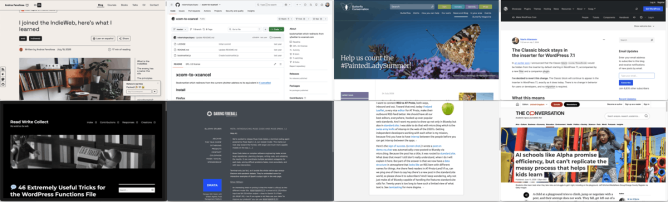
montages of screenshots of 8 webpages that are linked to in the article.

I’ve been using various IndieWeb ideas here for a fairly long time now, this is a great summary.

It was a movement with concrete ideas, protocols and an active community! As I read through their wiki, I understood their position and the intelligence of their proposals more and more. Such was my enthusiasm that I decided to follow their advice and adopt the protocols that made sense for my site. After finishing the tests and adjustments, I can confirm that the experience has been very positive: I have learned a lot, the UX of my website has improved a bit more, and I enjoyed the process.

I joined the IndieWeb, here’s what I learned | Andros Fenollosa

Every so often I hit a link to a tweet that twitter refuses to show me. Probably because of an ad-blocker I’ve set up and forgotten about. This might be the solution.

Bookmarklet which redirects from the current x/twitter address to its equivalent in X cancelled

bookmarklet which redirects from x/twitter to xcancel.com

I’ve seen quite a lot of painted ladies this summer, not as much as in 2019 the big year for them in Scotland.

Butterfly Conservation is asking nature lovers around the country to help count an explosion of exotic Painted Lady butterflies across the UK.

Help us count the #PaintedLadySummer! | Butterfly Conservation

I don’t use the classic editor much any more, but its disappearing might not be great for Glow Blogs. This is just about the classic block not the classic editor.

In an earlier post, I announced that the Classic block (core/freeform) would be hidden from the inserter by default starting in WordPress 7.1, accompanied by a new filter and a companion plugin.

I’ve decided to revert this change. The Classic block will continue to appear in the inserter in WordPress 7.1, exactly as it does today. There is no change in behavior for users or developers, and no migration is required.

The Classic block stays in the inserter for WordPress 7.1 – Make WordPress Core

Alway good to be reminded about function.php

I was inspired by this post to use WPCode to adjust how pages archive posts are displayed

💬 46 Extremely Useful Tricks for the WordPress Functions File | Read Write Collect

And a reminder that meta are not kind:

That’s over a 10× discount in exchange for giving your data to Meta. I can see the appeal if you don’t care about the privacy of your data and code, like, say, if you’re using Muse Spark to generate code for a throwaway project, or for something that’s open source anyway.

Daring Fireball: Meta: Introducing Muse Code and Muse Spark 1.2

Dave Winer on micro.blog. micro.blog is, i believe, one of the most amazing services on the internet.

I was able to do that with micro.blog which is the swiss army knife of interop in the web of the 2020’s.

Scripting News: Saturday, August 8, 2026

I am not teaching any more, I did a few days supply last session and might continue. I found A.I. useful for thinking about planning for stages I had not taught for years. But I used it a sounding board, and modified everything. Having pupils taught directly by A.I. might have some problems.

The deeper you look at how children learn, the clearer it becomes that this growing brand of alternative schools might remove the discomfort that often comes with learning – taking away what matters most as kids develop.

AI schools like Alpha promise efficiency, but can’t replicate the messy process that helps kids learn

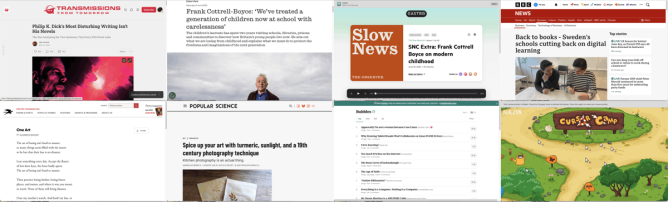
A montage of screenshots of the eight webpages discussed.

A varied collection of links some of which have been sitting in my notes for a while.

Frank Cottrell-Boyce: ‘We’ve treated a generation of chil…

They miss school? “School is where our kids feel secure. It’s where they’re fed. It’s their happy place. They don’t like the summer.”

Many times in different schools I’ve head about children that are troubled by the approach of summer. This is a great article. I’ve been disappointed by the Observer since it changed hands but this was well worth a read. A podcast episode SNC Extra: Frank Cottrell Boyce on modern childhood – The Slow Newscast was great too. That link is to Castro, I could not find a url for the source episode, even in the acast rss feed!


Philip K. Dick’s Most Disturbing Writing Isn’t His Novels

He came to believe that an unchanging reality–the Ancient Roman time of 50 A.D.–existed permanently underneath our perceived reality that occasionally bleeds through into ours. And people could only notice it if they were sensitive (or perhaps unstable) enough.
LLMs aren’t the traditional Terminator androids that science fiction warned us about. The problem with these glorified chatbots is more subtle, and one Dick actually identified: they are extraordinarily sophisticated generators of pseudo-reality. Fluent, confident, plausible text (plus images and video) delivered directly into the heads of millions of people who have increasingly limited tools for distinguishing it from reality. Deep fakes. AI psychosis. Misinformation. These are the pseudo-realities Dick was worried about when they were created by institutions.

I’ve not read any PKD for quite a few years, might be time to revisit or read some different ones?


Back to books – Sweden’s schools cutting back on digital learning

Sweden’s government is championing a renewed focus on physical books, paper and pens in classrooms, designed to reverse falling literacy levels.

But doubling down on analogue tools has drawn criticism from tech companies, educators and computer scientists, who argue it could impact pupils’ employment prospects, and even damage the Nordic nation’s economy.

The pendulum swings…


I Accidentally Built a Completely New Type of Website | Pootlepress

https://scrappy.world/ is a wee bit like the mac freeform app. Another interesting “store in browser” app.


Breaking the Spell of Vibe Coding – fast.ai

Similarly, AI can produce grammatically correct, plausible sounding text. However, it does not directly sharpen your ideas. It does not generate the most precise formulations or identify the heart of the matter.


Bubbles I’ve actually been getting some traffic from this site! Feed of posts from independent sites, as they happen or in a voted list. I’ve not tried the my feeds which let you create your own list. Sign in via mastodon.


Cursor Camp noted this a while back. Some fun.


I made a tiny pixel character creator called Pixabots. It generates 10,752 unique combinations from four categories — eyes, heads, bodies, and tops — all bouncing on a little idle loop.

This pack is a curated 2,000 of them, ready to use. Free.

Not sure where I saw this, there is a live editor at Pixabots — Pixel Character Avatars which is fun. Could be useful in class I think. Perhaps in Scratch when an uploaded gif is turned into a sprite with a costume for each frame.

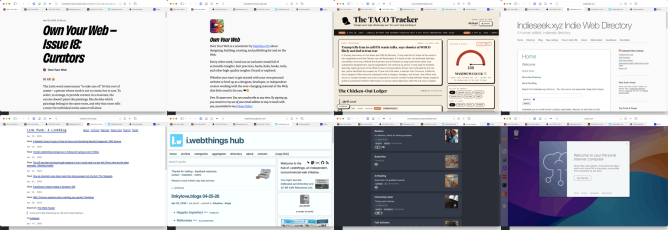
Montage of screenshot of thewebpages linked to in the article. Own Your Web – Issue 18: Curators • Buttondown Own Your Web • Buttondown About - Link Punk: A Linkblog i.webthings hub Commonplace Puter

I’ve not posted a set of links for a while, keep saving them, but retired life is busier than I thought it would be. I am prompted by this newletter post:

Own Your Web – Issue 18: Curators

So every time you share a link on your blog, every time you write a few sentences about why someone else’s work matters to you, every time you add a new entry to a blogroll or a links page – you are a curator. You are doing what no algorithm can do. You’re saying: I am a person. I read this. I think you should read it too.

There is a good selection of links to link curators.

I am not sure when I subscribed to Own Your Web

Own Your Web is a newsletter by Matthias Ott about designing, building, creating, and publishing for and on the Web.

But it is great. There is an RSS feed too.


The TACO Tracker: Every Time Trump Chickens Out

Trump won’t stop chickening out. We won’t stop tracking it

One of the more amusing uses of AI

Via brad who has the Indieseek.xyz Indie Web Directory

Indieseek.xyz is a small human curated, searchable, directory of web links to both websites and to individual web pages. We try and list pages that are informative, fun, classic and useful

And

Link Punk: A Linkblog

Just a linkblog, mainly for articles and individual blog posts that I find and want to share. I think of this as me being a DJ only playing articles rather than songs.

Brad also post funny political thoughts most days on mastodon.


Another great source of links is Joe Jennet
i.webthings hub

Welcome to the hub of i.webthings, an independent, noncommercial web initiative

Joe credits where he finds his links which can lead to some other interesting directories.


Commonplace

Commonplace is a self-hosted, federated link-collection manager. You can create curated collections of links and share them with followers across both the Fediverse (Mastodon, Pixelfed, etc.) and Bluesky — without creating new accounts on either network

Created by Doug Belshaw. And changing quickly. I am logged on via indieAuth, which is nice. I’ve created a few collections, the largest so far is AI Reading. It is always interesting to try out new pieces of software.

Commonplace allows sharing collections, suggestions and replies.

Commonplace now has a bookmarklet, which is for me essential. It grabs an image and description via open graph (I’d guess) to give a description. You can edit this and add curators notes.

I’ve used a bunch of link collectors over the year, delicious, pinboard, locally in the drafts app, on my site and a few more. I’ve not used pinboard much in the last few years. I feel a bit guilty about not updating my lifetime sub when pinboard changed to annual fees. Life-timers like myself could upgrade to a yearly fee. I didn’t. I mostly use drafts in a fairly disorganised way. At the very least commonplace is giving me the chance to think a bit about my link collection & sharing. It is also interesting to watch the development, as Doug is AI coding the site.


Here is an ‘real’ teaching and learning link. I’ve been doing the odd bit of supply and wonder if I should give this a go.

micro:bit CreateAI

micro:bit CreateAI is a free, web-based tool that makes it easy for students to explore AI through movement and machine learning (ML).

You can use micro:bit CreateAI to train an ML model and then run it on your BBC micro:bit V2.

  • Collect movement data from the micro:bit accelerometer
  • Train an ML model to recognise patterns in the data
  • Code the micro:bit to run ML models and take your creation anywhere.

And a last weird one.

Code seems like a computer on the web. You get a desktop. Also can create web apps and get access to AI. The UI has me baffled. I might not be the audience.

Mostly AI and weird audio

AI Fact Checker

Deep Background GPT Released – by Mike Caulfield

I just released a (largely) non-hallucinating1 rigorous AI-based fact-checker that anyone can use for free. And I don’t say that lightly: I literally co-wrote the book on using the internet to verify things. All you do is log into ChatGPT, click the link below, and put in a sentence or paragraph for it to fact check.

https://chatgpt.com/g/g-684fa334fb0c8191910d50a70baad796-deep-background-fact-checks-and-context?model=o3


Radio is a Foreign Country

THE RADIO DIAL IS A COMPASS; THE ANTENNA A DIVINING ROD*
Welcome to RADIO IS A FOREIGN COUNTRY!, an endless stream of obscure (and mostly retro) global music and audio ephemera rarely heard outside their home region.

Curated by humans not algorithms, our livestream follows a unique mixtape format where just about anything can happen and features cut-ups of international radio broadcasts (am, fm & shortwave), field recordings, ethnographic film, vintage records & cassettes, and digital ephemera from the far reaches of the internet. Our mission is to explore forgotten and new ways of making radio and to facilitate greater access and exposure to sounds and music not sufficiently documented by the commercial music industry.

Radio is a Foreign Country

via restlesslens


Halloween is Coming

Bob Dylan, Theme Time Radio Hour on SoundCloud

I’ll be missing the halloween activity in school this year this year.


Pootle Playground

Introducing Pootle Playground — My Experimental WordPress Blueprint Builder – Pootlepress

Uses AI to build a WordPress site that opens in the playground


Wiki Radio

The thrilling sound of random Wikimedia
Inspired by WikiTok, I thought I’d make something to discover sounds uploaded to Wikimedia. From political speeches and bird noises to genuine bangers, it’s mostly wholesome, though I cant guarantee it won’t play you something horrible once in a while.

Wiki Radio 📻

Hot Pi

Struggling to heat your home? Try 500 Raspberry Pi units • The Register

In this episode of the Fediverse Flows series, host Matthias Pfefferle sits down with pioneer technologist Dave Winer. The inventor of blogging, podcasting, RSS, and text casting. Together, they unpack the evolution of the open web, discussing why true interoperability and openness matter more than ever in an age of restrictive social media platforms.

The shownotes and transcript on this podcast are wonderful. The Takeaways, provide a great summary and worth reading after you listen.

I’ve been reading Dave Winer’s blog since I discovered rss. I’ve tried many of his more recent tools, including WordLand & FeedLand which he discusses here1.

Matthias Pfefferle is an IndieWeb & WordPress developer. I use his sempress theme & several of his plug-ins2 on this site. Recently he has been developing the ActivityPub – WordPress plugin . This allow your WordPress site to function as a federated profile. I’ve not tried that as I currently posse posts from here to mastodon via micro.blog.

Anyway, I’m a big fan of both participants.

A few interesting things

of the many in the podcast.

I don’t believe in comment sections on blogs, though. I think we could live without that, actually

Dave Winer

Like Alan I do like comments. I’ve read about bloggers who do not and mostly they are the ones with huge audiences. Apart from valuing the conversation, comments & even likes, which I fetch back via brid.gy, it does let me know that sometimes I am not writing into the void. I’d still blog for the void but it is nice to get some contact.
I’d guess bloggers like Dave dislike comments because of the way they can go on big sites.

But over time, what I hope happens is that people find that Wordland’s editor isn’t what they want. They want a different editor because you know what? There’s no one kind of editor that would please everybody.

Dave Winer

I’ve found this one of the most compelling reasons for exploring WordLand. WordLand is quite an opinionated editor. It has led me to think about all the different ways I’ve posted in the past and try out a few other options.

I think most of the younger generations are not aware of what a link is, what a URL is. They simply use one social network, and if they search for other users, they have that little search box and they search for the username. They do not understand that in a decentralized world that they may have to copy and paste URLs to find a new.

Matthias Pfefferle

This really spoke to me as a teacher. I am saddened by the way that even browsers hide paths after domains, and pupils just grab whatever google tells them. I have been surprised twice in the last few years by young kids, 9-11, doing something smart with urls or parameters.

I really enjoyed listening to this episode, lots of food for though. The ideas discussed become complicated quite quickly. A bit like the IndieWeb in general. Dave has of course been aware of WordPress but only recently started using it in earnest. Matthias comes from a different direction, the IndieWeb and Activity pub.

I’ve also now listened to another WordPress podcast with Dave: #186 – Dave Winer on Decentralisation, WordPress and Open Publishing – WP Tavern.

In this one Dave’s optimism and enthusiasm really shines through. I don’t know who it was told me, or maybe I read it somewhere: if you wait long enough Dave Winer is always right, Not sure that is true of anyone, but Dave Winer is always interesting & though provoking to read or listen to.

  1. Other products of Dave Winer I’ve used recently include:
    BingeWorthy 3
    Drummer
    1999.io ❤️
    ↩︎
  2. indieweb/wordpress-indieweb
    wordpress-indieweb-press-this
    WebActions for WordPress
    A Webmention plugin for WordPress
    ↩︎

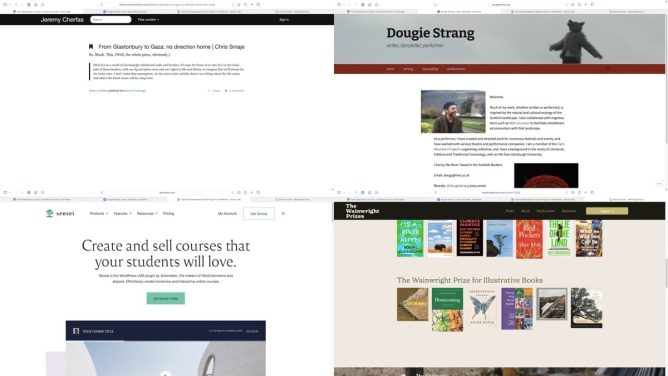
A montage of screenshots of plages linked in the post.

From Glastonbury to Gaza: no direction home

From Glastonbury to Gaza: no direction home | Chris Smaje a rabbit hole of links, to climate & farming, ht Jeremy Cherfas


Dougie Strang

Dougie Strang | writer, storyteller, performer I read a essay by him in Antlers of Water: Writing on the Nature and Environment of Scotland and more recently this poem: Poem That Avoids Arrest – Bella Caledonia

Much of my work, whether written or performed, is inspired by the natural and cultural ecology of the Scottish landscape.


Sensei LMS

Learning Management System Plugin for WordPress – Sensei LMS

Sensei Review: Transforming WordPress into a Dynamic Learning Platform

The Sensei LMS plugin allows WordPress users to create and sell online courses without relying on a separate platform. Free and Pro versions are available, so users can get a feel for Sensei before committing. While Sensei Pro isn’t quite as feature-rich as the leading standalone learning management systems, keeping everything within WordPress offers major benefits.


Wainwright Prize

Shortlist 2025 – Wainwright Prize

The Wainwright Prize, a celebration of nature and conservation writing, announces its 2025 shortlists. This year marks a bold new chapter, with three new categories reflecting the evolving landscape of environmental storytelling – particularly in how it reaches and inspires younger audiences.

Looks like a good list to check the library with.

Intriguing
via Steven Splinter

This is a fascinating read! I had a shallow understanding of what aphantasia is before reading this account of trying to remember without access to mental imagery.

Where the comments are interesting too.

I feel I’ve more than a touch of this, I don’t really visualise, have a less than perfect memory, and my facial recognition is poor. I am quite good with knowing where I am and navigation.