Read Exit Party Emily St. John Mandel ★★★★★

“I think if you live long enough,” Nico said, “you become a migrant from another timeline. There’s the world you learn to navigate as you enter adulthood, and then that world slips away from you by degrees, and after a while there’s nothing left of it, but you’re still here. That’s what I mean.”

And

He locks the studio door behind her, thinking about the poem again. The point isn’t that the candle won’t last the night. Everything is temporary. The point is that the light is gorgeous while it lasts.

Following several characters across two alternative worlds, the story moves from voice to voice, places to place and back and forward in time. Sometimes written in the close third other sections in first person. I enjoyed all of this.

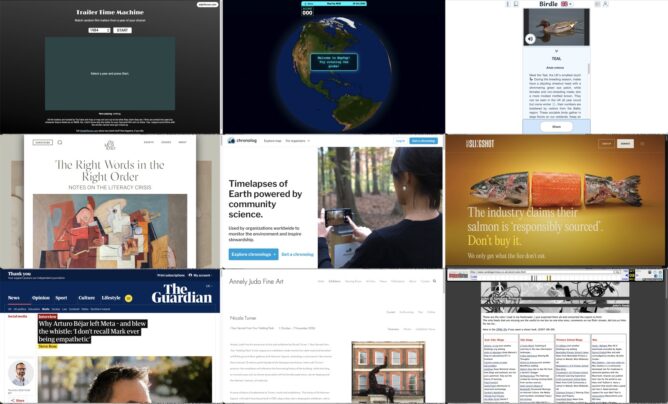
A collage of nine website screenshots, including a film-trailer selector, globe game, bird-identification page, literacy article, citizen-science site, salmon campaign, Guardian article, art exhibition page, and an older education blog.

Links I’ve collected at Links and Notes recently.

Fun

Trailer Time Machine Watch random film trailers from a year of your choice! I have clicke through a few from the year I was born (1958) and the year I went to university 1976, 58 seems a better year so far. Great fun.


I never got the wordle habit but I am finding these interesting:

MapTap.gg – Daily Geography Game I have been playing this for a week or two every day.

Birdle UK | Guess the Daily Bird

a fun way to encourage more people to learn about birds and bird conservation, no matter their experience level.

Facinating

The Right Words in the Right Order I posted about this earlier. LLMs, education, humanities & screens.


Chronolog 

Timelapses of Earth powered by community science. Used by organizations worldwide to monitor the environment and inspire stewardship.

Via @dogtrax. There is a map: Map | Chronolog. This looks great. Crowd sourced timelapses. There are none in Scotland.

Nicola Turner | 1 October – 7 November 2026 – Overview | Annely Juda Fine Art

A site-responsive installation made mainly from dark wool and horsehair will fill the ground-floor galleries at 16 Hanover Square, extending in a procession-like manner that continues 12 metres up the façade of the Georgian townhouse. Inline with Turner’s practice, the installation will reference the fascinating history of the building, whilst touching on myriad issues such as shame associated with the female experience, secret-keeping and the inherent ‘memory’ of materials.


Frightening

End Salmon Farming – Project Slingshot

All Scottish salmon sold in supermarkets comes from overcrowded, filthy, underwater factory farms, where parasites and flesh-eating sea lice are endemic. Investigators have filmed fish with damaged and missing eyes and whole chunks of their flesh eaten away.

Years ago I had a wee picture of the colour chat fish farms used to choose the colour of the salmon flesh on my sidebar linking to attempts to clean up salmon farming. Looks like it i still a problem.


Why Arturo Béjar left Meta – and blew the whistle: ‘I don’t recall Mark ever being empathetic’ | Social media | The Guardian

24.4% of 13-15-year-olds on Instagram said they had received unwanted advances, and 21.8% said they had been the target of bullying on the platform in the past seven days. Furthermore, 51% of Instagram users said they had had a bad or harmful experience in the past seven days. Only 1% of them reported it, and of those, 2% had the content taken down – so just 0.02%. This was a far greater degree of harm than the company’s existing measurements suggested. Zuckerberg never replied.


Finally

John @ Sandaig Primary John’s Feeds Some nostalgia from the internet archive, sites I followed via RSS in 2007. Not many still active.

These are the sites I read in my feedreader, I just exported them all and converted the export to html.
The only feeds that are missing are the useful to me but no one else ones, comments on my flickr stream, del.icio.us links for me etc.

Bookmarked The Right Words in the Right Order by William Davies.

As the education scholar Gert Biesta has argued, over the 1980s and ’90s the very idea of “education” was displaced in favor of an ideal of “learning.” Education implies a teacher, a subject, and a purpose; learning is something an individual does. What Biesta termed “learnification” meant that the transmission and application of knowledge became a priority across society and the economy in order to produce more active, independent, and prosperous citizens. Not only was “learning” (unlike “education”) something that could occur anytime and anywhere, but evidence of it would be found in practical applications, that is, the ability of individuals to achieve their goals. Pedagogy became anchored in cognitive science, so as to instrumentalize it in the service of economic ends

and

The threat posed by LLMs is not so much that they remove the difficulty of reading and writing (as the agonistic humanists would have it), as that they remove the playfulness, the uncertainty, and the intriguing mistakes.

What needs reviving is not some classical ideal of “Man,” but, as Weatherby argues, poetry. Textual generation, he writes, “puts poetry on one end of a spectrum bookended on the other by ideology.” Where we feel compelled to use the correct words in the right order, for fear of consequences, we are victims of ideology. LLMs allow us to witness our own ideological constraints, showing us how our culture has been streamlined, disciplined, and constrained into certain forms of expression. Poetry, by contrast, is the exploitation of the improbable, based on the assumed freedom to put words in an order that wasn’t expected and hasn’t been done before. The point is not that only humans can write an improbable sentence; machines can too. It is that a student should be free to try one, and to get it wrong.

I’ve lost the chain of link through which I’ve found it but I’ve come pack to this essay a few times over the last day or two. Brings together the problems of screens, LLMs, literacy, education and the humanities. Poetry seems to be a solution.

This struck a chord with me:

Such an agenda would need to also take aim at the Edtech industry, which has elevated “learnification” to new heights, profiting from the development of feedback systems that close down the space for experimentation, error, and creative nonsense.

I found using technology in the class a powerful way of engendering experimentation, error, and creative nonsense. From blogging poetry to glue-gunning cardboard I found some technologies very useful. Edtech and the tech giants with educational programmes have always seem suspicious. Teachers using or bending technology to fit the classroom has always seemed more interesting.

Unfortunately we do not seem to have avoided being lead by commercial technology despite suspicions being voiced over the years.

A really interesting essay.