montages of screenshots of 8 webpages that are linked to in the article.

I’ve been using various IndieWeb ideas here for a fairly long time now, this is a great summary.

It was a movement with concrete ideas, protocols and an active community! As I read through their wiki, I understood their position and the intelligence of their proposals more and more. Such was my enthusiasm that I decided to follow their advice and adopt the protocols that made sense for my site. After finishing the tests and adjustments, I can confirm that the experience has been very positive: I have learned a lot, the UX of my website has improved a bit more, and I enjoyed the process.

I joined the IndieWeb, here’s what I learned | Andros Fenollosa

Every so often I hit a link to a tweet that twitter refuses to show me. Probably because of an ad-blocker I’ve set up and forgotten about. This might be the solution.

Bookmarklet which redirects from the current x/twitter address to its equivalent in X cancelled

bookmarklet which redirects from x/twitter to xcancel.com

I’ve seen quite a lot of painted ladies this summer, not as much as in 2019 the big year for them in Scotland.

Butterfly Conservation is asking nature lovers around the country to help count an explosion of exotic Painted Lady butterflies across the UK.

Help us count the #PaintedLadySummer! | Butterfly Conservation

I don’t use the classic editor much any more, but its disappearing might not be great for Glow Blogs. This is just about the classic block not the classic editor.

In an earlier post, I announced that the Classic block (core/freeform) would be hidden from the inserter by default starting in WordPress 7.1, accompanied by a new filter and a companion plugin.

I’ve decided to revert this change. The Classic block will continue to appear in the inserter in WordPress 7.1, exactly as it does today. There is no change in behavior for users or developers, and no migration is required.

The Classic block stays in the inserter for WordPress 7.1 – Make WordPress Core

Alway good to be reminded about function.php

I was inspired by this post to use WPCode to adjust how pages archive posts are displayed

💬 46 Extremely Useful Tricks for the WordPress Functions File | Read Write Collect

And a reminder that meta are not kind:

That’s over a 10× discount in exchange for giving your data to Meta. I can see the appeal if you don’t care about the privacy of your data and code, like, say, if you’re using Muse Spark to generate code for a throwaway project, or for something that’s open source anyway.

Daring Fireball: Meta: Introducing Muse Code and Muse Spark 1.2

Dave Winer on micro.blog. micro.blog is, i believe, one of the most amazing services on the internet.

I was able to do that with micro.blog which is the swiss army knife of interop in the web of the 2020’s.

Scripting News: Saturday, August 8, 2026

I am not teaching any more, I did a few days supply last session and might continue. I found A.I. useful for thinking about planning for stages I had not taught for years. But I used it a sounding board, and modified everything. Having pupils taught directly by A.I. might have some problems.

The deeper you look at how children learn, the clearer it becomes that this growing brand of alternative schools might remove the discomfort that often comes with learning – taking away what matters most as kids develop.

AI schools like Alpha promise efficiency, but can’t replicate the messy process that helps kids learn

An interesting post from Matt Mullenweg:

Builders are the site shapers, webmasters, the agencies, the companies, the content managers that think in a more page-first rather than post-first way. Tagging? Blogroll? Date-based permalinks? Who needs them. Give me custom fields, rich templates, a site editor, to craft beautiful sturdy pages that will stand the test of time. A store with a catalog of items where what changes is the inventory and ratings, not the content.

The Builders right now dominate our core development discourse, which makes sense. They hold a lot of the economic share with merchants and rich websites.

Our Core Division | Matt Mullenweg

There are some interesting comments on the post too.

I’ve been thinking a lot about Glow Blogs over the summer, in particular the shift to the block editor. Currently creating a new site on Glow Blogs defaults to the classic editor and a classic theme. You can optionally choose create a site with a block theme and default to the bloc editor when making a site, or switch around later.

Given the direction of WordPress is the block editor it makes sense to change to make the block editor the default. Over the past few years we have provided a fair bit of information on the block editor. Not so much on the site editor.

Our users are not typically The Bloggers or Builders Matt talks about, but teachers, other school staff and sometime pupils. They have other jobs to do1. Schools do need sturdy pages that will stand the test of time and teachers might find the blogger approach to tagging useful. Designing presents more of a difficulty.

The approach I am thinking of at the moment would be a compromise. Advice on how to do the least amount of work to get a chronological record/blog type site or an information type/school site that start to work quickly.

For example for a chronological blog site: Twenty Twenty Five theme; edit the header to have a nice image; swap the footer for a simple one without links leading nowhere; change the heading blog; edit the Sample page to make an about page. Start blogging. Obviously a school site would be more complex.

A next steps could perhaps add some ‘widgets’, categories & tags to the footer, swap colours with the styles section of the site editor and the like.

That would certainly have been enough to get me started in class blogging. Concentrate on the content.

  1. Personally I found blogging about what I did in class was one of my most useful tools, but I do enjoy blogging anyway. ↩︎

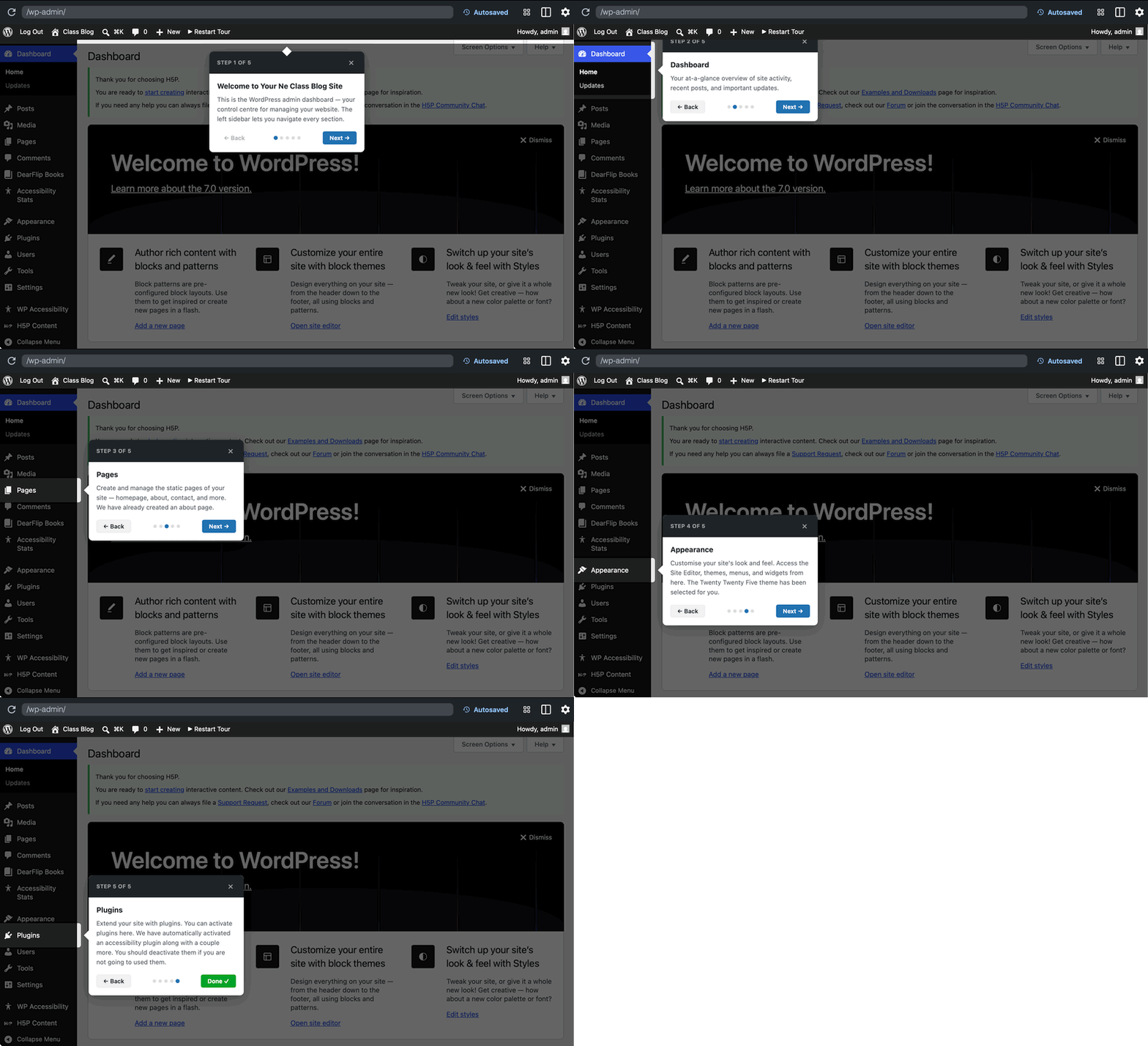
Animated gif of screenshots of a 'tour' of the wordpress dashboard made with pootlepress playground.

I’d also love to know what you think of the broader idea. A WordPress Playground that doesn’t just show people a site, but actively teaches them how to use it.

Turn Any WordPress Playground Into a Guided Education Experience | Pootlepress

This looks like something with amazing potential, a way to build in guided tours in the WordPress editor. It works in the WordPress playground via pootleplayground.com. Pootle Playground helps you create blueprints for the WordPress Playground1.

There are technologies I know little about only have dipped my toe into. The featured image is a gif of a simple tour I created in a few minutes. It does look like there could be great potential for WordPress environments like Glow Blogs2. Teachers are busy multi-skilled people. Making a WordPress site might not be in their skillset but might be in their remit.

I could see something like these guided tours working not in the playground but in a site itself. A teacher or pupil could choose a tour to work through, say a class blog, e-portfolio or school site, the tour would take them through the steps to get started.

  1. Quote: WordPress Playground is the platform that lets you run WordPress instantly on any device without a host. It’s your place to build, experiment, test, and grow. ↩︎
  2. I am just throwing out ideas here. Lots of coulds. ↩︎

How To Build PHP-Only Gutenberg Blocks In WordPress 7

PHP-only blocks are an ideal migration path for existing shortcodes. The render logic is often identical — the only difference is where the parameters come from.

As a very amateur and occasional dabbler in shortcodes & very simple plugins this looks interesting. It will need WordPress 7 and php 8.1. There are already quite a few how to articles out there already.

At WordPress.com, we believe short thoughts deserve a real home. Today we’re introducing a new theme built for quick posts, replies, and reblogs: the kind of writing that lives somewhere between a tweet and a blog post, on a site that’s entirely yours.

from: A New Theme for Short-Form Blogging on WordPress.com – WordPress.com News

A new setup on wordpress.com with front end posting, 500 char limit in their editor, but you can go past that if you use an alternative editor, WordLand for example.

It is not clear to me if the features go with the theme, or there is a plugin I can’t see at work. I’ve only got a free WordPress.com account. It looks like you could change the theme.

Of course it would be interesting to see this on self hosted WordPress sites. I did experiment with a telex block that gave simple short form posting. Not quite in a popup, but could be useful on mobile.

Update: Manton has some thoughts: Manton Reece – WordPress short-form interface.

Arrangement of tinker toys

Since I been trying out my.wordpress.net I’ve been thinking a lot about this.

Of course Alan has been there first: This is Not a Blog | wordpress as the new hypercard?

I spent a lot of time with HyperCard over the years1. Described as a “software erector set” and “programming for the rest of us” it was one of the inspirations for the web.

I used it for toys, tools and fun for pupils at school. I also made many utilities for myself. These did not need to be polished, just fit closely to my needs and tweak-able. For many years I used HC every day.

HyperCard could make mac application, but you could also run stacks (documents) in the application by itself.

Over the last few days I’ve been playing with my.wordpress.net which is a complete private WordPress in your browser. One of the limitations, at the moment, is that you get 1 instance per device/browser. I found that using Safari’s Add to Dock… feature, which gives you a single site application you can click and launch from the dock, allowed me to have several copies of WordPress that ran with a click. It began to feel a bit like HyperCard.

Like HyperCard you can edit the code while running. I mentioned here I was able to swap out the lyrics of the hello dolly plugin in a minute. Of course more complex things would need more skills, and php & javascript seem a lot more complex than HyperTalk to me.

The other thing HyperCard was great at was sharing ‘extensions’ external functions (XFCN) and commands (XCMD), similar to WordPress plugins.

At the moment My WordPress feels as it if useful for playing around, testing things quickly & safely and maybe making utilities for yourself.

I’ve already used it to explore a problem I didn’t understand, made a couple of test utilities and experimented with a them or two. This was much quicker than using the web.

I suspect that a ‘real’ single site generator app might give more options than Safari. One of the annoying things for me was that the open in New Tabs links in WordPress spawned windows all over the place. Switching from other apps became difficult. I got round that problem by asking claude.ai to create a simple plugin that switch all the links to same window. This now really reminds me of stacks.

Wondering

My WordPress makes it really easy to edit all of the WordPress files. That feels a little dangerous to me. I wonder if a better approach might be to have a wee plugin to add code when you need too. Sort of like functions.php in a child theme but theme independent. A system for JavaScript files could site in that plugin folder too? Both could be easily edited in the browser and keep me away from more risky files. I am pretty sure there are already plugins out there that do this.

Another application this reminds me of is TiddyWiki which I use to keep various notes. TiddyWikis are single html files. I have multiple wikis that run from the TiddlyDesktop: A custom desktop browser for TiddlyWiki 5 and TiddlyWiki Classic. I could imaging something similar for My WordPress.

Other things in the mix include:

  • WordPress Playground which I’ve not used for more than a few minute, I am not sure what the differences between the playground and my wordpress are? It looks like my WordPress is for longer term ideas.
  • Blueprints Blueprints are json files used to set up a WordPress Playground instance. I briefly tried Pootle Playground – WordPress Blueprint Configurator which easily produced a blueprint linked to playground and when opened started WordPress installed the themes and plugins I had added like magic. I think this would be a great way to share apps. Not sure if you can use it with My WordPress? yet?
  • Playground has a setting to set up a multi-site. That might be interesting in My WordPress…
  • Telex, Describe your idea. Telex will build a WordPress block or theme for you.

Finally:

Next up, we’re going to add peer-to-peer sync, version control integration, and cloud publishing so other people can access it.

WordPress Everywhere | Matt Mullenweg

Featured image Tinker Toys by Flood CC-BY-NC-ND

  1. My favourite piece of software, followed closely by SuperCard. ↩︎

Your Browser Becomes Your WordPress – WordPress News

With my.WordPress.net, WordPress runs entirely and persistently in your browser. There’s no sign-up, no hosting plan, and no domain decision standing between you and getting started.

My WordPress is an interesting development. It allows you to have a totally private WordPress site in your browser. You could use this to test, develop or just play around with WordPress. It also looks like it could be used for developing an app just for yourself, or perhaps to export & share. There are a couple (via plugins) than can easily be installed, including an RSS ‘reader’. Everything is stored in the browser, limited to 100mb. I was surprised as I thought local storage was much smaller than that? I wonder where it is stored.

There seems to be ways to back up or transfer to a live site.

The obvious frustration might be if you make something useful it will be only on one device/browser but that might be balanced by the privacy.

It only takes a few seconds to set up the site and it feels fast.

It seems to emulates MySQL using SQLite

Looks like I have access to all the files. I tested this by adding a shortcode to the functions.php and it just worked!

I could also edit the Hello Dolly plugin, replacing the lyrics with the ones from Subterranean Homesick 

Blues.

RSS

One of the Apps you can install is an RSS reader. This is the Friends plugin. I have briefly tried this before, but I think this is an opportunity to give it good test. I easily added a feed or tow. It did not work with scripting.com, I presume due to it being severed via http not https?

AI

Another suggested ‘apps’ is AI which allows you to connect to an AI if you have a key. I do not pay for any AI so do not have a key. By chance I installed Ollama yesterday, a local AI, I am not sure what I am doing just following Miguel Guhlin’s notes.

I spent quite a lot of time messing about with this and failing, I think because Safari is so uptight about mixed content. I did get it working in Firefox, but running into this problem means I can’t do anything yet.

So I think I’ll leave the AI assistant alone for the moment and play with other things.

Screenshot of the playground screen in my.wordpress.net shows a list of apps to install, backup and other options.

Other Things & Thinks

I am slowly thinking about how I could use this in a useful, or fun way.

  • Trying things out that I do not want to risk on a ‘real’ site and don’t want to set up a whole WordPress for.
  • Learning, especially quick tests & tries, themes, snippets, css etc.
  • ‘Apps’ that look interesting, but I don’t want to be public.
  • AI integration with WordPress. I’ve been experimenting with Telex a bit, wondering it will be incorporated in this.

I am sure there are more. The limits, at the moment, seem to be one site per device/browser. For little things this could be easily worked around using the offer:

Want multiple Playgrounds? Open temporary instances that reset on refresh.

More…

According to Matt Mullenweg there is a lot more in the works

my.wordpress.net has soft-launched.

Next up, we’re going to add peer-to-peer sync, version control integration, and cloud publishing so other people can access it.

and

Today, everyone gets a phone number and email when they grow up. That will expand in the future, everyone will have a domain and a WordPress. A part of the internet that you own.

from: WordPress Everywhere | Matt Mullenweg