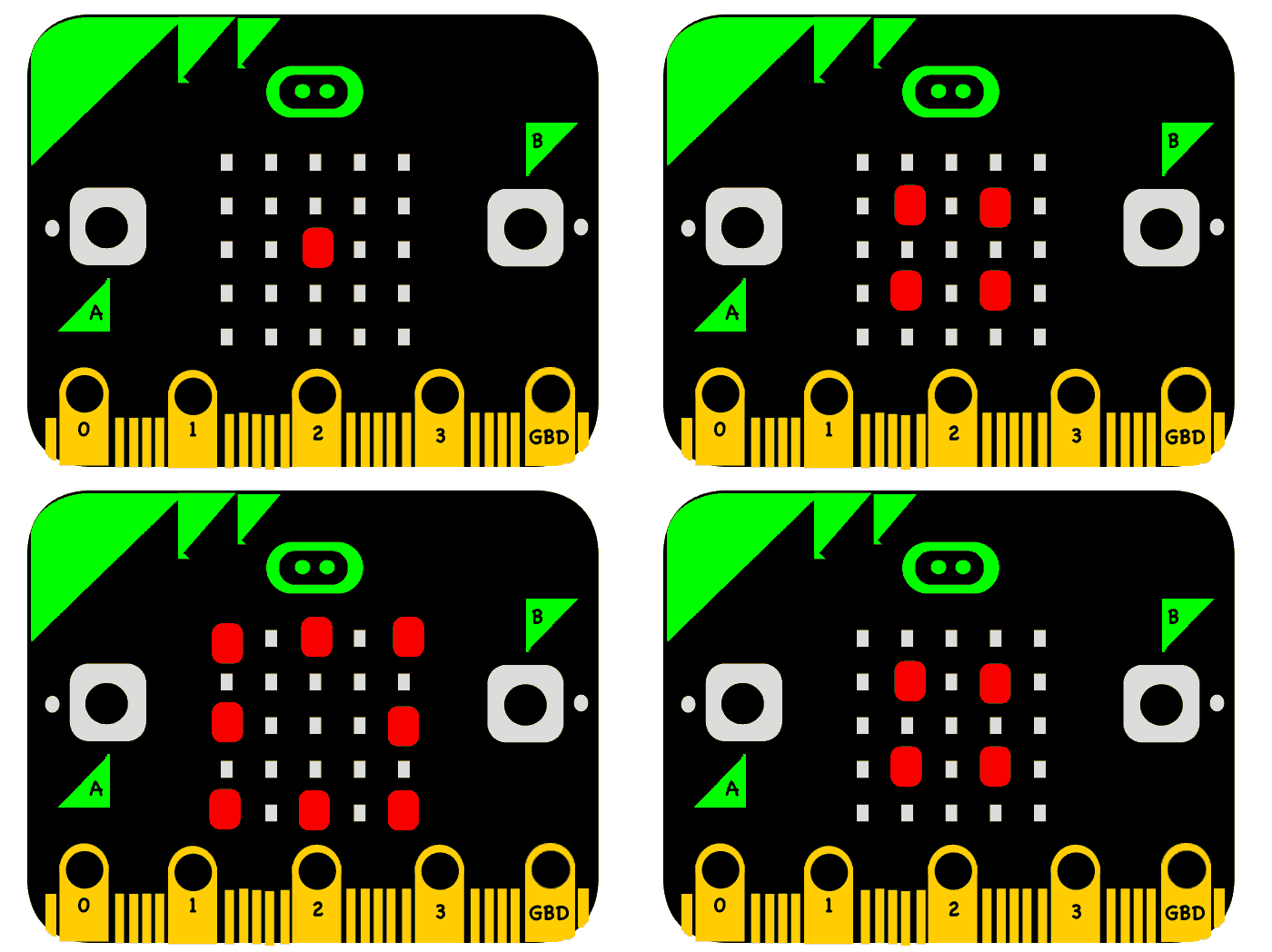
Over the last few years I’ve had quite a bit of fun with micro:bits. Given I’ve been using the same ones all that time they were pretty good value. It is great to see them getting a bit more traction in Scottish schools.

We are to get some more free ones: Scottish schools to receive 20 micro:bits. This will be great. I’ve got access to plenty but the new ones have some nice new features. Built-in microphone, speaker, capacitive touch sensor, and power save button. The speaker will be particularly welcome, avoiding a bit of footering . The power button too as I’ve found that detaching the battery is quite tricky for small fingers. I hope they arrive soon.

There are also a lot more support events & materials for classes appearing.

19 May 11 – 11:45 Code Along with micro:bit – Relaxation & Mindful Breathing looks fun, but clashes with our sports day. My class did participate in a couple of similar scratch events via Teams. Although these were not anything I could not have covered myself. I did find the pupils were extra engaged with a virtual teacher and peers.

You don’t even need micro:bits to take part,

Micro:bit not required as you can still take part using the MakeCode simulator.

Which until this week I would have though was missing the point. The other day I was re-introducing some of my class to micro:bits. They had made simple rock, paper, scissors shakers. We were discussing the problem of knowing, for sure, if the shake had worked. Two similar results could be due to random selection or by nothing happening. While the pupils were playing with solutions to this one explained he was not going to flash the micro:bit every time. He preferred the simulator! This surprised me, as I think the device is a big draw for most pupils.

The other week New support for teachers launched today | micro:bit. I’ve already found the examples and projects on makecode.microbit.org very useful. I am looking forward to getting to try the ones for the new micro:bits.

In class we have been using the iOS micro:bit app rather than the web. This solves the issue of flashing the micro:bits via usb by using Bluetooth and works really well. We did a bit of work on our arcade devices this session. That meant pupils using the web downloading hex files on their iPads, air dropping to a MacBook and then transferring to the devices. Bluetooth avoids the “one MacBook” bottleneck.

The other bit of micro:bit information I have is that Glow Blogs now supports the embedding of the micro:bit simulator. This enables pupils to share their creations and keep a record of their achievements. I’ve just updated the microbit instructions for Glow Blogs. I hope to see some examples in the wild soon.

Well I am quite excited. There is a new plugin in Glow Blogs, H5P. This is quite different from anything else in blogs.

H5P is a system for creating interactive HTML5 content. It can work inside several types of publishing platforms including WordPress.

The range of content types that you can create with H5P is pretty wide. Some are ways of presenting material, accordions, image galleries. Others are learning activities, quizzes, multi-choice questions, word searches and crosswords. More sophisticated types include interactive video. Videos can be paused by viewers to respond to questions and quizzes and 360 tours. Responses to quizzes, cloze procedures etc are gathered from logged on users.

You can combine these content types , or display them on a blog in different ways.

I’ve spent a bit of time making some simple examples for Glow Blogs which has allowed me to start to think about how best to use these.

I’ve also started to build up a small bank of resources for spelling for my class: igh example. So far I am only scratching the surface.

I’ve always enjoyed making online resources for my classes to use. but these can take a lot of time and can be difficult to make presentable or present. The H5P plug-in solves many of these problems and are made “inside” the blog.
Having them on a blog allows resources to be quite easily organised. The Display Posts plug-in or using the make theme helps. Post listing in Gutenberg will be useful too.

Here are a couple of examples embedded from Glow Blogs.

A 360 tour:

and a fill in the missing words exercise.

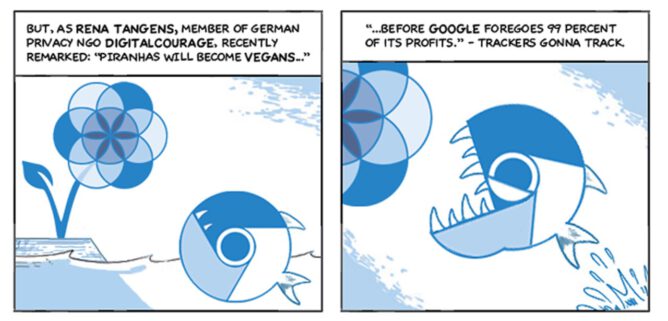
In Contra Chrome, Leah carefully charts this road and its terrain in a funny and easily accessible way. In webcomic form, she documents how over the last decade, Google’s browser has become a threat to user privacy and the democratic process itself.

Contra Chrome is a pretty amazing pice of work from any angle.

The fair use of Scott McCloud‘s Google-commissioned Chrome comic from 2008 is a nice touch.

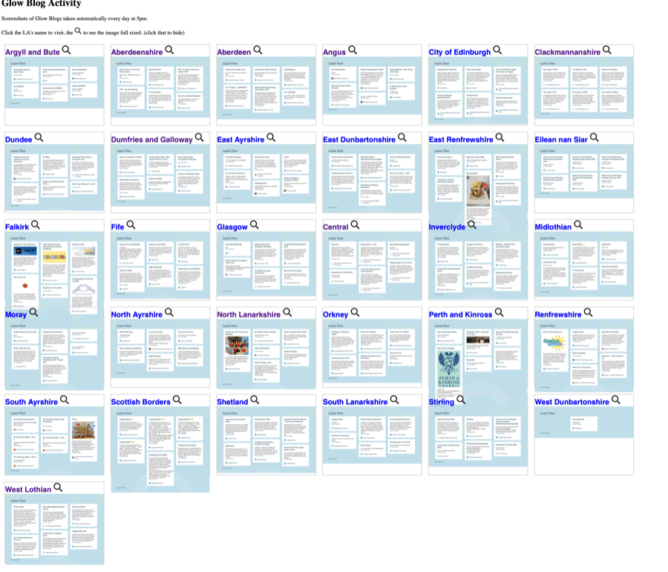
screenshot of pi.johnj.info/gb

One of the things I am interested in as part of my work on Glow Blogs is what people are using Glow Blogs for.

Glow Blogs is made of of 33 different WordPress multi-sites. One for each Local Authority in Scotland and one central one.

The home page of each LA lists the last few posts. Visiting these pages will give you an idea of what is going on. In the past I’ve opened up each L.A. in a tab in my browser and gone through them. I had a script that would open them all up. I’ve now worked out an easy way to give a quick overview.

Recently I noticed shot-scraper ,Tools for taking automated screenshots of websites . I’ve used various automatic webpage screenshot pages in the past. These have usually been services that either charge money or have shut down. I used webkit2png a wee bit, but ran into now forgotten problems, perhaps around https?

shot-scraper can be automated and extended. It is a command line tool and using these is always an interesting struggle. I usually just follow any instructions blindly, searching any problems as I go. In this case it didn’t take tool long.

Once installed shot-scraper is pretty easy to use. shot-scraper https://johnjohnston.info Dumps an image johnjohnston-info.png

There are a lot of options, you can output jpegs rather than pngs. Run some javascript before taking a screenshot or wait for a while. you can even choose a section of the page to grab.

So I can use shot-scraper to create screenshots of each LA homepage. Then display them on a web page for a quick overview of Glow Blogs.


    #!/bin/bash

    cd /Users/john/Documents/scripts/glowscrape/img

    URLLIST="ab as ac an ce cl dd dg ea ed el er es fa fi gc glowblogs hi in mc my na nl or pk re sa sb sh sl st wd wl"
    for i in $URLLIST ;
    do
        /usr/local/bin/shot-scraper -s "#glow-latest-posts" -j "jQuery('.pea_cook_wrapper').hide()" --quality 80 https://blogs.glowscotland.org.uk/"$i" -o  "$i".jpg && continue
    done;
    

This first hides the cookie banner displayed by blogs and then screenshots the #glow-latest-posts section of the page only.

The script continues by copying the image over to my raspberry pi where they are shown on a web page

I hit a couple of problems along the way. The first was that the script stopped running when it could not find the #glow-latest-posts section. This happens on a couple of LAs who have no public blogs. adding && continue to the screenshot fixed that.

The second problem came when I wanted to run the script regularly. OSX schedules tasks with launchd. I’ve used Lingon X to schedule a few of these. Since I recently updated my system I first needed to get a new version of Lingon X. I then found that increased security gave me a few hoops to jump through to get the script to run.

I think it would have been simpler to do the whole job on a raspberry pi. But I was not sure if it would run shot-scraper. I’ll leave that for another day and a newer pi.

This is a pretty trivial use of a very powerful tool. I’ve now got a webpage that gives me a quick overview of what is going on in Glow Blogs and took another baby step in bash.

The first thing that surprised me was the lack of featured Images on the blog posts. These not only make the LA home pages took nicer they also make display blog posts on twitter more attractive.

Interesting & scary thread for those at BETT and other education events. Linked abstracts worth a peek.

I’ve had to search for this one several times so putting it here so that it might make it stick or be easier to find.

Sometimes working with my pupils I want to send them to a blog, have them logged on but not go to the dashboard.

the login url has a redirect_to parameter.

So I I use a url like
blog-address/wp-login.php?redirect_to=page-I-want-the-pupil-to-go-to

Where blog-address is the blog I want them to log on to and page-I-want-the-pupil-to-go-to is a relative or full url

I often share notes to my class via AirDrop and hide long urls but typing a name, selecting it and making it a link, ⌘-k on mac. Unfortunalty you have to create linked text in another app on iOs and paste it in.

Read Searching for Kid-Friendly Searching | flower.codes
I set about trying to find a kid-friendly search engine that enabled exploration, while still protecting her from the toxicity of the greater modern web. And, guess what? I failed.

And,

If my kids want to search for dinosaurs, they should be presented with educational and otherwise appropriate websites to help them learn about dinosaurs; not a full page of ads for dinosaurs before they see the actual search results

I do not see much discussion of this from within education, I wonder why not?

Yesterday I read Alan’s post Right? or Choice? To Repair (or Joy Thereof) #DLINQDigDetox – CogDogBlog. One thing in particular caught my eye:

And yes extend broken devices to broken technology. Can’t play old flash content? Try Ruffle.

I’d not heard of Ruffle, but I though it was worth a quick try. I searched my hard drive and was delighted to find  rommy.swf.

Rommy has been reborn several times, born as a HyperCard stack in the 1990s, then a SuperCard project, arriving on the web via the Roadster plugin that ran SuperCard projects. The final incarnation was in flash (although I might have a javascript effort somewhere).

Anyway I uploaded the swf and htlm file, adding the link to the ruffle javascript library & it worked not only that it works on an iPad.

I don’t suppose it is of much use in the classroom now, back in the HyperCard days I though the idea of pupils creating mazes and then getting their partners to write instructions to go through them was a good one. I had not see it else where is such an easy to use fashion.

The featured image is a gif captured with licecap, it doesn’t make the annoying beeping that the real one does.

Bookmarked Free Background Remover: Remove BG from HD Images for Free | Erase.bg (Erase.bg)
Make the background transparent for images of humans, animals, or objects. Download images in high resolution for free for e-commerce and personal use. No credit card needed.
Seems to do what it says on the tin. The transparent png files are larger. I added a red background and exported as jpg here. Could be useful in school, we normally use keynote & instant alpha. I switched the editor to Blocks added the image compare above and then switched back to classic to use the post kinds plugin.