Whether explicitly stated or not, this is precisely what I see many folks advocating for with our students and educators alike. Telling kids to be careful and thoughtful in what they share is important. Telling them to be calculating and strategic is dangerous. It might be a good thing to consider if you’re selling soap but not if you’re a human being. I see people applying these principles being applied to the way they interact online. The things they share are strategic. They share content and ideas they know will get a lot of views/likes/retweets rather than things that are simply interesting to them. They are careful to maintain the desired reputation of their brand. The schedule their posts and content to get the most traffic and interaction. None of these things are inherently bad but when this criteria drives you, I think you’ve crossed the line from human to brand.

Source: If I Ever Think of Myself as a Brand, Slap Me | Ideas and Thoughts

Love this post from Dean Sharski, I think this is how I’ve subconsciously chosen to pay attention to folk. The more machine like they are the less likely I am to pay attention.

Hence my recent tweet:

I don’t particularly want to have professional twitter account. I do think about what I share and I don’t think I’ve ever posted anything that would scare the horses, but a fair proportion of my online life is nonsense. Some of this eventually feeds into my life as an educator but some might appear quite strange sometimes. I tend to post different things different places, this blog steers clear of ds106 related things, gifs go to tumblr but everything ends up on twitter in a messy stream.


Featured image: Tiger Brand on Flickr  No known copyright restrictions.


One of my favourite blog post series, Tom Woodward‘s Weekly Web Harvest had a good haul this week including a link to this delightful twitter bot, moth generator (@mothgenerator). I took a few hours to get my moth but worth the wait.

The bot generates a moth image from the text you tweet it.

The talk will give a view of how blogging with WordPress fits well with Scottish education’s ‘Curriculum for excellence’. Some loose linkage of Community, Connections & Openness in software and education. How Glow blogs, a set of 32 multi-sites with a total of >160,000 blogs are used and are developing. Some notes of the ‘Product Owner’ role and working at large scale to fit the needs of stake holders from a wide range of ages and needs.

Source: Speakers | WordCamp Edinburgh


I am talking about Glow Blogs next week at  WordCamp Edinburgh not my usual audience of colleagues so wish me luck.

Urban Dictionary: wean.

My raspberry pi, was having problems. For a while it had sat on the windowsill happily posting images to tumblr day and night on skypi and broomhill sky’s, it served up a small website itself too.

At some point it stopped working. I rebooted the device a few times, turned if off and on again, then left if for another day.

I had a bit of time on my hands on Thursday so decided to story it out. Since the device didn’t seem to be working at all, I could not connect to it via ssh and it was not serving the website I though I’d better just start from a clean install. So this is what I did.

  • bought a new SD card.
  • downloaded a new image from NOOBS for Raspberry Pi
  • wiped the card and copied the files over
  • moved the pi to the living room and hooked up the to and a keyboard
  • booted the pi and went through the initial setup
  • shut down the pi to prepare to move it back to the windowsill where I planned to connect via ssh and redo all the server and script stuff to get it working.

At that point, while the pi was still hooked to the tv I though I’d give the old card a final try. Of course it booted up straightaway!

I then took the pi with the old card back into the other room and connected to power and ethernet. Back to the Mac and tried to ssh on. Fail, check the website that sits on the pi, fail.

Finally I took the Ethernet cable out of the powering plug and put it back in again. Everything started working properly.

I do not know how many times I’ve repeated this sort of routine expecting the worst and skipping the obvious. I do hope I’ve learnt my lesson but somehow I doubt it.

On Tuesday this week we released the Glow Blogs e-Portfolio plugin

The biggest reason for creation of a blogs in the Glow Blogs system has be e-Portfolios. There are 10s of thousands in the system. Until now the system used was based on one of 60 different e-Portfolio themes created by Alex Duff during his time at Education Scotland.

The old system had a couple of problems, firstly the creation of blogs was time consuming due to the way the old Glow Blogs were hooked into SharePoint, secondly the themes all needed maintenance and updating. This maintenance would be expensive as the 60 themes were all different. The amount of development and testing would have needed more resource and time than we have available. The first problem was solved when the blogs were decoupled from Sharepoint in October last year. The e-Portfolio plugin solves the second.

Early on in our planning of the new WordPress blogs in glow and the migration of the old plots we decided that the best way to tackle this was to move away from theme based e-Portfolios to ones based on a plugin.

This plugin would produce profiles from posts that were added to the blog. The profile is really the only way that the e-portfolio blogs differ from a standard blog.

Initially our thoughts were to separate the e-Portfolios and other blogs onto two different instances of WordPress with different functionality. At the start of development it became apparent that this would be both technically difficult and would risk loss or damage to the data in the system. As we got nearer to the old system being shut down it was decided that the e-Portfolios would be developed in a future phase after the initial migration and upgrade to the WordPress software.

During this time we did develop the requirements for a new system, and over the past year I’ve discussed these plans with a lot of our stakeholders. The requirements were put together and rationalised beautifully by Sonali Nakhate who was first the business analyst and then project manager for Glow Blogs.

We finally had space and time to start developing the e-Portfolio solution and Stephen Harris was brought into the team to carry out the development. Stephen took our ideas and turned then into an elegant solution that fits in seamlessly with the WordPress backend. For example on the profile creation screen you can reorder the sections of the profile by drag and drop. You can also tab through the sections and use the arrow keys to move the sections up and down.1

Running along side this development and feeding off the requirements was the creation of a test plan. David Orr and Grant Hutton from the Glow test team planned to test all of the new functionality and equally importantly that the new features does not break any of the old ones. As development finished the test team fed back and the odd bug were found and squashed. It is testimony to Stephen that the testing took less time than planned allowing us to get to release ahead of schedule.

The development and test teams are coordinated and run by Geoff Turnbull Glow’s technical architect, Geoff also fed into all aspects of the blog requirements gathering and development from the start. Many other members of the Glow team fed into the process along with colleagues from the digital directorate and other parts of Government (procurement, security and more). All of the blog team are also involved in other parts of the Glow program too.

There are still two other phases of e-Portfolio work planned, the adding of class sets to user mange to and a way for teachers to easily see activity from the pupils they are working with without having to visit individual sites to check for activity. I am look forward to watching these developments from a bit further off as my secondment finishes at the end of this month.

One of the most interesting and enjoyable parts of my secondment has been the chance to work in the blog team alongside these folk who both understand their respective jobs and how they fit together. In the past when I started blogging and podcasting with my pupils I hashed and bashed my way through the technicalities, it has been delightful to see the way this can be done well at scale.

We are developing some help for the e-Portfolio plugin on the glow blog help site.

1.
I think the biggest smile I’ve had on my face in the last couple of years was on first seeing this page.

Featured image: Team Working Flickr by Mauro Public Domain.

UoD EduShare | The central sharing hub for #UoDedu teacher education students at the University of Dundee

Derek described the project succinctly:

On of the things I am most happy about in my involvement in Glow Blogs is the syndication plugin. The UoD EduShare site is a better example of its use than I could have hoped for.

UoD EduShare aggregates posts from student teacher’s blogs at the University of Dundee. In the short time it has been running it has pull in links to and excerpts from over 400 posts from over 90 blogs. A few clicks and a bit of reading shows how involved the students are with their learning and an enthusiasm for sharing their thoughts.

I am excited about this project because it is a great example of what blogs and syndication can do. Longer term we will have teachers entering the profession with a great understanding of this digital environment.

Bugs and Fixes

Previously I’ve used the syndication plugin a couple of times now for Blogging Bootcamp #2 and #ShareOurLearning. These are smaller aggregations than the one Derek is running. In fact Derek found that the plugin had problems. Once he had added around 70 blogs he could not add any more.

This bug has been fixed and the fix applied to the blog service last week. We are currently very lucky in having a great team working on Glow Blogs. Our technical architect prioritised this as a degradation of an expected service and between our developer and test team a solution was found, developed, tested and released quickly.

DIY

If you are a user of Glow Blogs and want to use the syndication plugin there is a help page on using the plugin: Syndication Plugin and I’ve put together a page on Running An Aggregated Course or Collaboration in Glow Blogs. I’d be more than happy helping folk get started with using the plugin on Glow Blogs.

sites I take a lot of screenshots. Mostly I use the standard mac keyboard shortcuts or the home + sleep buttons on iOS or less frequently the snipping tool on Windows. These are all covered on How to take a screenshot. I find the mac ones to be the best for general purposes, lots of options at your finger tips.
Occasionally I’ll use other tools:

webkit2png a command line tool if I need to get a lot of webpage screens quickly or to do some automation.

Paparazzi a mac app gets images of full pages including the off screen sections.

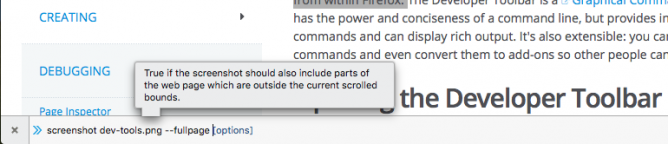
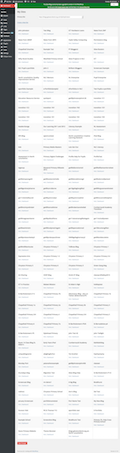
Firefox’s Developer Toolbar is a new one to me. The Developer Toolbar gives you command-line access to a number of developer tools from within Firefox. One of the things it does is take screenshots, which can be of full pages. I used it to take this screenshot of the Glow Blogs Sites page (resized for display here).

To use the firefox tool you open the Developer tools (Shift-F2) and this opens a wee box at the bottom of the page where you type commands. For example

screenshot dev-tools.png --fullpage

Will save a png of the full pages into your downloads folder, the file will be named dev-tools.png

I tried this iPhone app out before the summer on the recommendation of Ian Stuart. At that time it was not integrated with O365/Glow and its main selling point seemed to be it took great pictures of whiteboards and straightened them up nicely.

Back then I gave it a try and it did that job, but not, IMO, as well as Scanner Pro. Scanner Pro is £2.99. (I like paying for apps, if you are not the customer…).

So last week when Ian mention that it was now integrated with O365 for business/school (ie Glow), I didn’t get that excited but I did download it. Not being at a conference or near a whiteboard I just did a quick scan of a newspaper and saw that it uploaded.

Continue reading

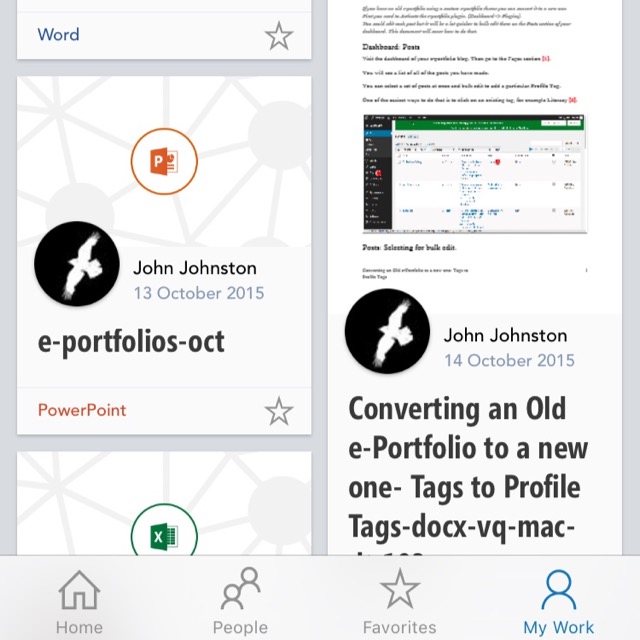
Hot on the heels of Sway comes Delve. This is a sort of search engine come Pinterest for O365.

This post is just a quick note. I’ve only spent an hour or so last evening having a quick look at delve in the browser and iOS app.

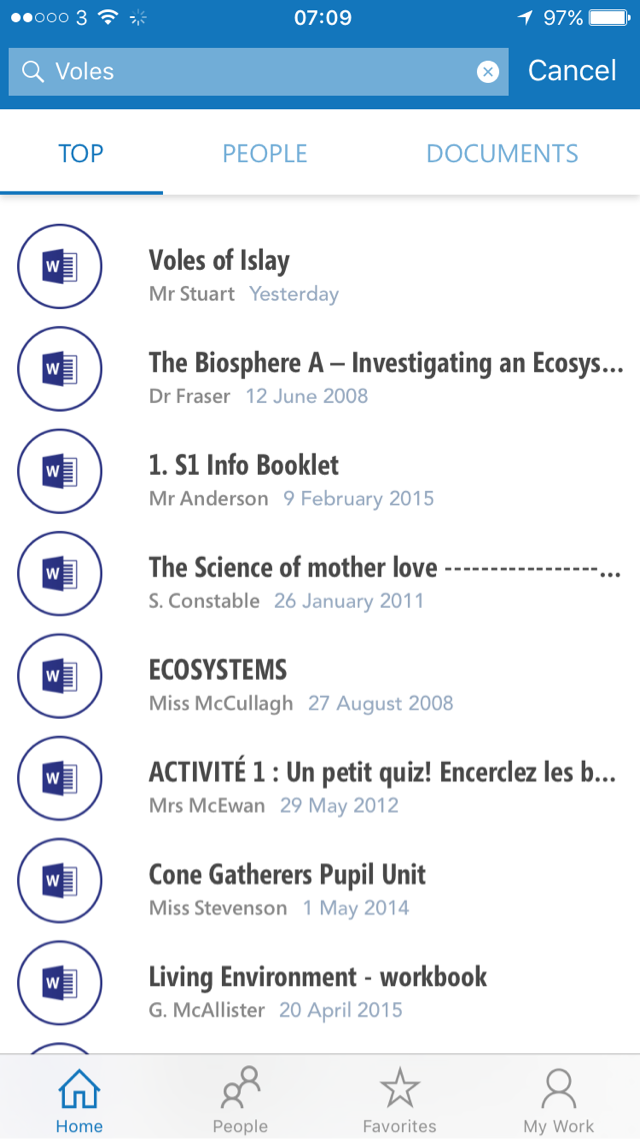
I have been amazed by the results of searching. Who would have thought there were so many results for ‘voles’!

If you have a glow account it is worth heading over to O365 and opening delve from the waffle. Then just search for something.

Next step is to start a board. This is the Pinterest bit. The more folk that do this the more interesting it will get. Boards are not supported on the iOS app but appear in the works. Boards are shared, looks to me like a collection of tags. It seems to take a while sometimes for these to come through if someone else tags them.

I’ve not really spent that much time in the O365 bit of glow.  I have been fairly critical of sharepoint in the past but delve looks like it might be the most interesting part of the whole O365 setup.

More info on the Glow Help Wiki.


You can opt out of sharing your stuff on Delve, but I am not sure why you would, other users only see your documents if you have share those particular docs with them.