Since the last post I’ve continued to messing around with twitter.
My facebook and twitter script has stopped working, due I think to changes on facebook, but I’ve become more interested in twitter. It is not much use in school, because it is blocked in Glasgow primaries, but it has been interesting watching the tweets spring up when I am at home. I’ve installed Twitterrific a sweet, free, desktop app, to view and post to twitter. I am beginning see the use for firing off quick informal questions but even more interesting are some mashups.

The most educational of these is twitterlearn :: micro language-learning from the Radio Lingua Network. Basically you can follow learnitalian on Twitter, it will give you tweets of short phrases to translate into italian and a link to provide the answer in a blog post. So in the twitter feed you see:

Translate into Italian: “I’ve already visited Rome” http://tinyurl.com/2osa6g

Clicking on the link will take you to the answer.

twittermap

The nice thing about twitterlearn is that it uses another service twitterfeed.com which posts RSS to twitter automatically. so the questions are produced automatically from the blog posts that combine questions and answers.

I’ve used twitterfeed.com to post this blog to my Twitter and created a new twitter account for scotedublogs.org.uk : ScotEdublogs on twitter, if you follow the ScotEdublogs tweets you will know when new posts arrive at SEB. (there is one for teachmeet07 too).

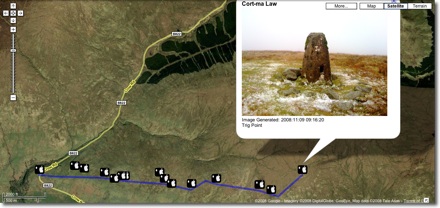
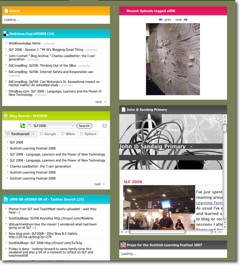
I’ve also looked at twittermap which allows you to set your location in a tweet and places you on a google map, via the google maps api. This is connect to twittervision which show tweets poping up all over the place and provides pages for users showing where they are: twittervision: johnjohnston

I am still unsure where twitter would fit into a primary pupil’s learning but there are lots of interesting things being done with twitter now.

I’ve been reading a pile of stuff about twitter over the last few months. Quite a few edubloggers around the globe have taken up tweeting in a big way. I originally thought that it would be more use to conference goers than class teachers and didn’t pay much attention.
Yesterday I saw that a facebook friend was wondering how to update his status on facebook and on twitter at the same time.
This remined me that both twitter and facebook have APIs. A bit of googling took me to ”More status updating goodness‘ where Sören provides an applescript for quicksilver to update several status messages at once, including twitter and facebook. I took the script and simplified it a bit, got rid of the quicksilver stuff other services and I am afraid removed the keychain scripting for the faster hard coded username and password.

So I am thinking of what good scripting these services would do. I guess you could combine the script to tell other twitters what you are playing in itunes, what you are reading in safari, or some other information grabbed by AppleScript either locally or via a webservice. You could run thse in an idle loop so that someone could twitter the current webpage they are reading, application they are using etc. Would this be useful? Eventually a scriptable phone could twitter its geolocation…

teachmeet07

Now I am on twitter I’d appreciate some contacts, my username is johnjohnston.
It is not all that likely I’ll be doing much tweeting for now. I do look forward to seeing it it is a useful tool at the Scottish learning festival and TeachMeet07.

Speaking of which the planning for TeachMeet07 is well under way. Check the wiki or follow everything Tagged: Teachmeet07. It looks like being a great event.

On Thursday I went over for a holiday visit to Lourdes Secondary School to visit Lori Ramsay. At the last Glasgow Masterclass meeting Lori had presented a tantalising view of The Mothership which seemed to involve enterprise, podcasting and music. Wendy from Edict invited me to get in touch with Lori to find out more and I popped over to the southside of the city on Thursday morning.

Lori met me and took me to a music classroom full of macs, keyboards and other musical gear. She booted up one of the few macs in Glasgow City Schools and launched into a garageband lesson! This was great, I’ve steered clear of GarageBand except for the occasional voice and background podcast as I have the musical ear of a turnip.

Lori quickly showed me how to teach children to put together a short song or jingle, first blocking out drums, then rhythm and synth followed by some instruments, until we had a wall of sound ‘blocks’. She then knocked holes in the wall to create an intro, verse and chorus. This would be broken down into several lessons in class, but you could really see how excited the children would be. Lori gave me quite a few bit of essential information that a musical person would understand and that I can follow. I an now ready to teach some music watch out for the effect on Radio Sandaig!

Lori explained that she was not a teacher, although she teaches sound engineering at Lourdes, she has a professional sound engineering background. She brings the real world into the classroom using the enterprise model. The pupils learn radio production and sound recording skills at SQA Int 2 Higher and Advanced Higher levels. I m sure that the string of backstage passes hanging on the wall and working with an expert from the real world wil ladd to the positive effect of working on a ‘real’ task.

Sound Studio Lourdes Secondary School

Next Lori took me through a well equipped music studio to a soundproof room where the music could be edited and Radio Shows created. We listen to some of the children’s work. It was immediately apparent that the sound quality was much better than you usually find in a school podcast. We listened to professional sounding music, intros and voiceovers the pupils organising and running the shows. Some of the music was produced by the pupils and some by independent musicians. I was surprised to find that the children produce not podcasts but streaming audio. This is wrapped up in copyright issues, the station plays music from up and coming bands. I asked how they got the music expecting that they would be pulling it from music sharing sites, Lori pointer to a huge pile of CDs these were sent in by aspiring bands to play on the show.

Lori told me the pupils organised a event at the Garage night-club in Glasgow. The show included signed and unsigned bands including some musicians from the school. A & R folk from major record companies turned up. Undoubtedly this has had a real effect on the pupils involved, Lori mentions the positive effect on their attitude and that they are learning real world skills as they gain academic success. The program has a neat fit with the Curriculum for Excellence as well as enterprise.

Next we went online to take a look at the The Mothership.

The first function of the site is the streaming radio station where you can listen to the pupils productions, pupils from 4 Glasgow Secondary schools and one primary are involved:

Central to The Mothership project is the production and streaming of radio shows created by the students in a real professional studio environment. The studio, based at Lourdes Secondary School is available to students on allocated ?studio nights…

Plans are afoot to expand the number of schools involved.
As well as the music section of the site there is a password protected, secure section as well. This allows pupils to log on and download learning resources or take quizzes on the site. There are also chat rooms which are opened by teachers to help with homework and pre-exam revision. The site is still under development but plans are that pupils will have alien style avatars which they will be able to customise as the gain points through completing learning activities. Lori explained that the design of the site was reviewed by the pupils whose feedback has enabled the web designers to produce what the pupils wanted.

There is an interview of lori on her work on the Bluesbunny Independent Music Reviews Site : Mothership Project

Overall the Mothership project is very impressive, hitting academic, enterprise and Curriculum for Excellence targets. I am looking to taking Sandaig’s broadcasting, audio and video, to a more formal enterprise model this session and hope to get on board.

Over the last couple of weeks I’ve been reading quite a few post as about what makes a good edublog and blog identity. Eventually I ended up on Andy Roberts’ Writing an About page where he followed the advice from lifehack.org , I’ve done the same. I’ve started working on an about page. It is pretty clunky at the moment but if you are interested in where I am coming from it might give you an idea.

I’ve never really wanted to do this, but I notice if I visit a blog and can’t find who/where the person is it makes me wonder.

I’ve also exported the blogs I read in my feedreader and converted it to html. If you want to see what I read most days you can on the subs page. Pretty much as it came out of the reader, I just deleted those handy feeds that are only of interest to me, del.icio.us for me, comments on radio sandaig, comments on my flickr etc.

What do you think, do you want to know a bit about who is writing a blog, are a pile of links useful?

I’ve a page with a bigger version:A walk along the canal and you can see this on voicethreads too.

Obviously I’ve been trying out voicethreads which has had a fair amount of linkage on various edublogs.

I’ve only made one show but voicethreads is a very sweet application. Wesley Fryer has a nice post VoiceThread versus BubbleShare comparing this with bubbleshare, voicethreads seems to win.
Briefly voicethreads lets you upload (or grab from flickr) photos and turns them into a pretty slideshow, you can then add audio and text comments and drawings all in your browser (flash). You can title and link your slide to external pages too.
Next you can share your slideshow and viewers can add comments (again audio, text or drawings) the interface is extremely easy to use. Vociethreads call this Group Audio Blogging(GAB).

Even better you can keep the show private and moderate or turn off comments. Even better you can add different identities to a voicethread account without new emails, so everyone in your class can work on the same show adding comments. An identity is just another name and photo/pic (weemee anyone) associated with your account. This process is clearly laid out in the voicethread Classroom.

All in all voicethread looks like a wonderful app for classroom use, to start: whiteboard select photos, individually add audio or text comments; next: groups plan shows take photos, or draw and scan and build show. Children could tell a story, report on a trip, provide instructions for others, explain a concept, report on an experiment etc. etc. etc….

I am looking forward to find out if the voicethreads site gets through our filters and then plan some fun in a week or two.

Please feel free to leave a comment on my voicethread, to try out the comments.

technorati:

Tasty Tumble 2

Over the holidays this blogs sub heading: mostly what we are doing with ict in class is becoming less and less true, it really should be ‘today I have been mostly messing about”. This post is no different.

A couple of posts ago I was writing about turning my del.icio.us rss feed into a tumble log, which turned out to be a matter of parsing the rss and making the fonts big. Compared to a real tumblelog it lacked a bit of colour as it was text only, big text but just text.

Today I messed about with the script a bit more and it now shows a flickr photo if there is a flickr photo page in my del.icio.us links and embeds youtube videos if the link points to a youtube page. This is done in a pretty crude fashion and it is probably not too robust, but it is working ok for now. I should probably do something for images too, but that would mean figuring out how to resize then on the fly to stop big ones blowing away the basic page layout. I don’t suppose I really bookmark images very often (well not al all).

So here is the basic page: A Tasty Tumble

What is perhaps useful in all of this fun is the idea that it could be adapted for classroom or group link sharing. To present a set of materials combining photos, videos and links in a slightly more interesting and accessible way to a class or group you just need to point the pupils to a particular tag (or combination of tags), for instance here are some Scratch Resources

At the moment the script only looks at my del.icio.us links, and the only parameters are tag and number of posts to show. but it would be easy enough to vary the user-name with another parameter.

As usual I am not sure where this experiment will go, but it might serve as an example of how easy it is for amateurs to mashup free rss feeds and api keys using free tools.
In this case I am using the Magpie RSS – PHP RSS Parser to get and parse the del.icio.us feed, the phpFlickr class to access the Flickr API and show flickr photos.

Anyone got any use for this sort of thing?

Sandaig Home 0707

I’ve spent most of today messing about with the bits of school website that are not blogs, doing a wee redesign. Mostly I’ve just made the existing site a little more curvy using the lovely Nifty Corners Cube Javascript/css technique.
Unfortunately the site has been built on the hoof over quite a few years and has some really tangled stuff in the mix. Still at least the home page validates (except for the cluster map). I should really pull it all down and start again, but I think that would take a wee bit too long, one day perhaps. I was hoping to redo all the header graphics, but it seems that I’ve left all my photos of the school building in school.
Someone recently suggested I move to some sort of CMS but I’ve not found one that has the flexibility of a separate blogging system and they seem a bit of overkill for a wee school site. The bit that really needs a clean up is the photo gallery a guddle of html, flash, html with lightbox posted over the last few years as I’ve changed my mind about how to upload and present images without too much work. What I would really like is to turn it all over to Flickr and just play with that. Maybe with the youtube dust being kicked up by panorama we might be able to get flickr past the filters next session.

Tasty Tumble

I was talking to Ewan yesterday about tumblr and how nice it was. I didn’t explain to well at first and he was thinking of something like del.icio.us.
so this got me thinking and here is my del.icio.us feed as a tumblelog.

Produced using the Magpie RSS – PHP RSS Parser from my bookmarks on del.icio.us

The more I’ve used tumblr the more impressed I’ve become, very slick and easy to post to. I’ve moved mine to its own domain, just because I could tmblr.johnjohnston.name

technorati tags:

&my_tumblelogTumblr

After talking about it I decided to try out a tumblelog, using in this case Tumblr: John’s Tumbelog. Tumblr is a very nice application and keeps things clean and basic, there are half a dozen types of post; text, photo, quote, link, chat and video which are all easy to make either from the dashboard, a bookmark flavlet, mobile or a OS X widget. The bookmarklet is pretty smart, if you are on a flickr page it pretty much does it all for you, same with youtube, if you have some text selected on a web page and hit the bookmarklet it knows you want a quote, pulls the text and link into the popup window and all you need to do is click Create Quote. Nothing selected and it knows you want to create link.

It takes about 2 minutes working slowly to set up Tumblr the whole interface is clear, the blogs created look good and you can tweek the css with a nice web interface or just choose a template.

I don’t think tumblr blogs would be useful for primary pupils but they might have a place in sending interesting videos, links etc to you pupils if you don’t want the hassle of setting up a blog and just want to let the children see the content. For someone with a large numbr of readers it could be a nice way to share links and ideas alongside del.icio.us.

For myself It seems a fun tool but I don’t know if I would get the readership. For the moment I’ve folded my into my SuprGlu aggregation..

Interestingly the official tumblr blog uses wordpress the explanation highlights some of the differences between tumblelogs and blogs as does kottke: tumblelogs and Wikipedia

Tumblr is in very active development, scanning the last few post on the Davidville blog gives hints, there is an API, quicksliver hooks, a Pro version in the works and some community building.

Tools

imagewell_paparazzi I’ve been using a few new to me/rediscovered desktop tools over that last couple of weeks (pc users can turn away). I already blogged about ImageWell which is a great image prep and upload app for quick annotation, resizing and adding drop shadows without opening a big image application. The more I use it the more I am impressed.
my Flickr tagged imagewell.

I’ve also been using Paparazzi! which is a screenshot for webpages application.
I wanted to get a screenshot of my tumblelog but include more than one entry which was way off the screen Paparazzi lets you do that. You then can drag the image from Paparazzi to ImageWell resize it, optionally add a drop shadow and notes and then upload to flickr (or dotmac, or ftp etc), very quickly indeed.
The top image I dragged to the desktop and then dragged that file to TextMate while writing this post, the one on the right I sent to flickr with ImageWell. (I really love the drag and drop stuff when using a mac, especially when combined with command tab to move through applications).
Another handy free tool for grabbing screenshots is desktopple this hides the icons on your desktop so you can get nice clean screenshots, and set the background colour. Together with the usual screenshot keystrokes these apps make a great image to blog workflow at no cost.

desktopple