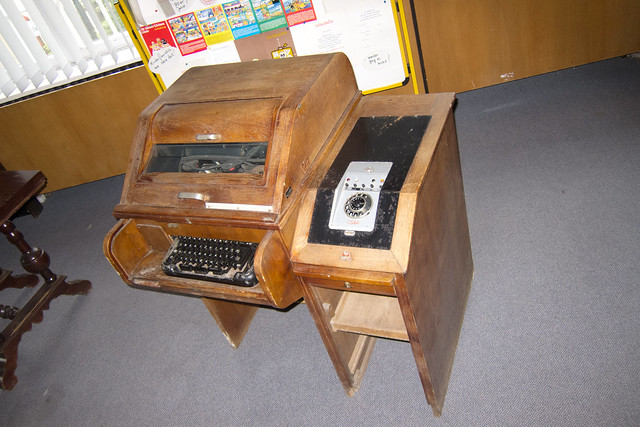
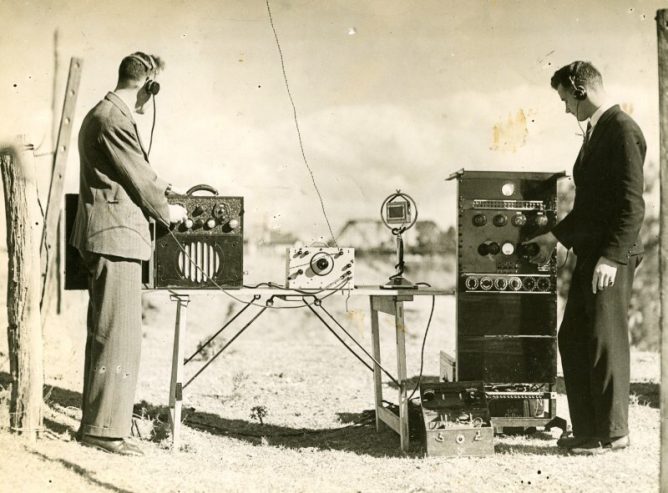
The secretary, a compartmentalized working-space, may be thought of as the RSS reader of the past.
from: #tds389 The RSS reader of days gone by | The Daily Stillness
The linked post, is really only a paragraph but the idea in it is wonderful.Â
Today, I wrote a post on my 1999.io blog, read my RSS reader, tweeteted, answered tweets, found somelovely stuff. I worked on a website and went back an forward many times on email.
The image of a bureau captures this delightfully. I imagine a webpage version that looks as organised as the image posted.
Teachers should care about Pokémon Go! – after from the initial network effects (craze) as it is a good way for kids to develop socially. It isn’t designed for education and certainly presents the all too common accessibility issues of commercial games – but THIS game leads you to start thinking about why games, play and learning are important – and how they can be connected with helping children deal with saturated media cultures – Great!
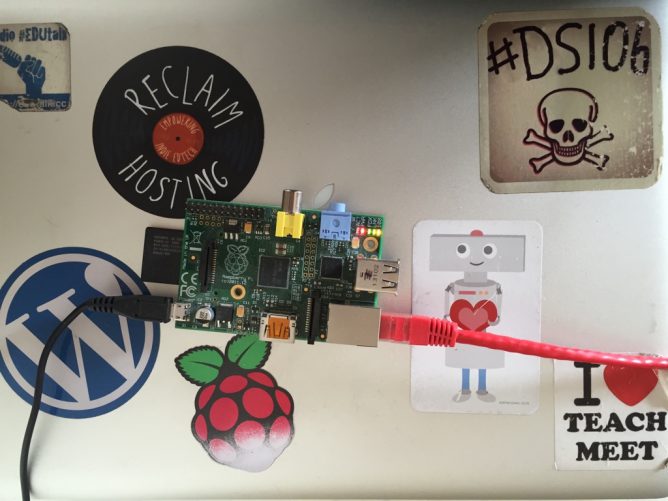
After 38946 gifs and 24660 jpgs my Raspberry pi has stopped taking photos.
I am not sure why but it stopped recognising the camera module. I’ve decided to give that a rest while keeping the pi going as a server for other things. I’ve also moved it from the windowsill to a better position on my local network.
I’ve also bought a Pi NoIR camera which I’ve used on my other pi, grabbing photos every minute of the bin outside our window in the hope of catching some foxes. It is not posting to the web, but over the network to my mac. My poor craft skills mean it was balanced on some cardboard and slowly slipped through the night. No foxes were photographed on the first try. I’ll be getting a better mount and trying again.
I’d like that, second, pi to be portable with a few buttons to do different things, start timelapse, grab and post a gif, etc. I’ll need to learn a bit more.
This will hopefully be a useful reference for me and perhaps others.
I’ve been thinking about Facebook quite a bit recently. I still only visit occasionally and feel fairly negative about it. When I do visit I often see interesting things about folk I know, but not enough to make me visit more often. I also recognise that it can be used for really interesting projects for example the EAST Project we talked about on on Radio #EDUtalk.
The video, linked to by Alan, held my attention for the full hour (I find it hard to watch online videos for more than a few minutes).
Yesterday I tweeted a link to a great post, the transcript of a talk about some social aspects of technology and how allowing technologist to lead our progress might have negative impacts on our privacy and lives, here is a quote.
Those who benefit from the death of privacy attempt to frame our subjugation in terms of freedom, just like early factory owners talked about the sanctity of contract law. They insisted that a worker should have the right to agree to anything, from sixteen-hour days to unsafe working conditions, as if factory owners and workers were on an equal footing.
Companies that perform surveillance are attempting the same mental trick. They assert that we freely share our data in return for valuable services. But opting out of surveillance capitalism is like opting out of electricity, or cooked foods—you are free to do it in theory. In practice, it will upend your life.
This spoke very much to some thoughts I’ve been having about our relationship to technology companies. Some of these were sparked by Dean Groom, Why not to buy Minecraft Education Edition. Some more idaea were discussed at the Always on (them) event at the University of the West of Scotland and I am in the midst of exploring those in a few microcasts, tagged DigitalUWS & microcast (one down a few more to go).
I’ve not come to any great conclusions but I do think it is something we should be thinking a lot harder about.
More grist arrived today from Stephen Downes:
I can see how the presentation would engage school leaders looking for a way to address current trends in learning, but they need to look beyond the single-vendor approach proposed here, and they should be clear that technology companies are service providers who are held accountable for delivery, not partners taking a hand in pedagogical and educational decisions.
I know myself enough to recognise that I am somewhat enthralled by technology and software. I certainly need to think about my relationship, on so many levels, with the technology I use. Should we be addressing this in the classroom with our pupils?
featured image is probably walking a copyright tightrope, but seems appropriate
Last week I attended the morning of the Always on (them) event at the University of the West of Scotland. This was organised by Professor David McGillivary. It looked at Digital and Social Media use in Education.
As Natasha Dow Schüll shows in her excellent bookAddiction By Design: Machine Gambling in Las Vegas, while casino operators want us to think that addiction is the result of our moral failings or some biological imbalance, they themselves are to blame for designing gambling machines in a way that feeds addiction. With social mediaâ “much like with gambling machines or fast food” our addiction is manufactured, not natural.
Today’s stillness prompt connects with the idea around software design I’ve been thinking about recently.
On the one hand, I’d guess, GUI designers are trying to help us do something; communicate, connect etc.
On the other if we don’t pay for their services, they are serving the service. We, or I certainly, forget this when thinking about how a piece of software works.
I also wonder how deep it goes, I notice that phone apps that I’ve turned notifications off for fell quite different that ones I’ve left them on for.
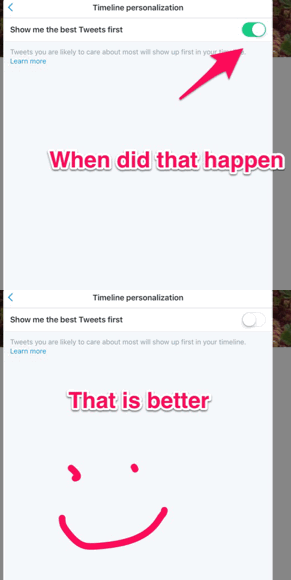
Some things seem to slip by but are still under our control:
But there are surely a lot more subtile things that we normally don’t notice or understand going on that will require a fair bit of mindful attention if we are to even notice them.
On Thursday I attended the Always on (them): Digital and Social Media use in Education event at the University of the West of Scotland. This was organised by Professor David McGillivary.
I only stayed for the morning as I had to get back to run a twilight course. Very disappointed to have to leave early as the morning set up some great questions for discussion in the afternoon. I was speaking just before lunch and as I listened to other speakers I had to update my talk on the sly.
I recorded the audio for all morning speakers for edutalk, I’ve now posted them with a DigitalUWS tag.
In my presentations I briefly described my own history of blogging and podcasting at Sandaig, Glow Blogs and ended with some questions. Preparing for the talk allowed me to think sound some ideas that have been buzzing in my mind for a while. I hope to tease them out in a few subsequent posts or microcasts.
We get hung up on “ease-of-use” in software, as if that was the only dimension to judge it. But social software architectures must be judged not on ease of use, but on the communities and behaviors they create, from the invite email to the labels on the buttons. If one sentence can make this much difference, imagine what damage your UI choices might be doing to your community.
I believe we need to think a lot more about the software we use and the effect it has on communication and on us. Hopefully I’ll think a bit more about this in some subsequent posts/microcasts.
If you didn’t make the event I’d recommend listening to the audio and the Twitter stream #DigitalUWS has some good stuff too.
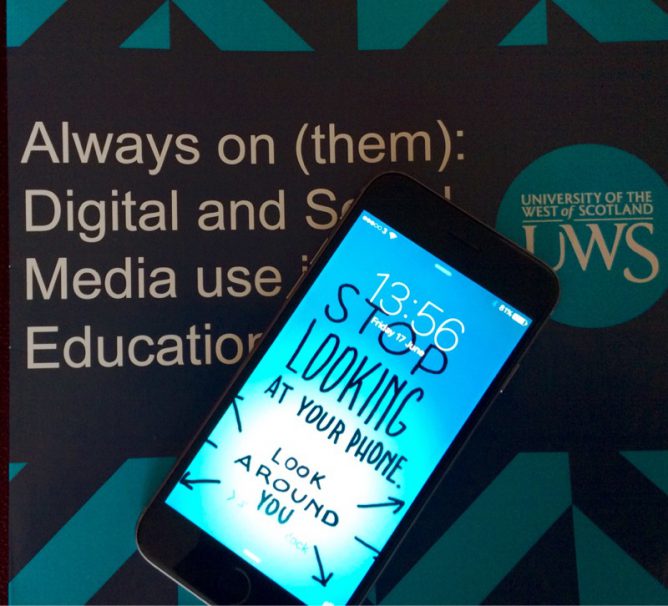
Featured image, my own photo, I though my lock screen image is relevant to some of the things I was trying to talk about.