
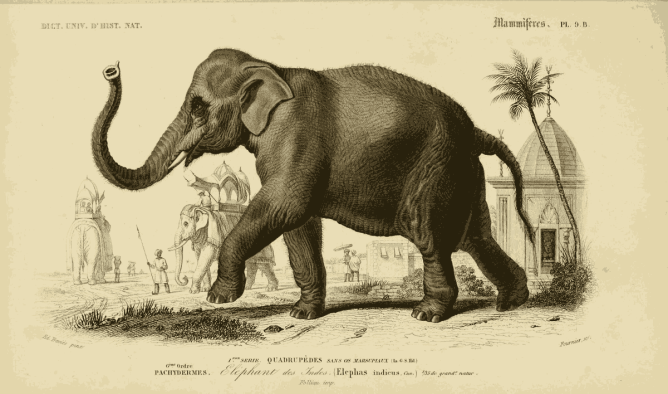
sepia Illustration of an Indian elephant with background structures and a smaller scene with another elephant and men. t from Dictionnaire universel d'histoire naturelle 1847

I used to love Martin Hawksey’s tweet archive which I used for quite a while and mirrored on the web.

Yesterday I was reading Alan’s post: My Digital Cleanup: IFTTT – CogDogBlog which explains how he now archives toots with make.com a sort of ifttt replacement. This sounds very useful. I’ve quite often failed looking for old toots with the mastodon interface.

This made me think a bit. I’d been playing with json to sqlite for my flickr photos, On this Flickr Day. I wondered if I could do this with my toots too.

Turns out I could take a very similar approach:

  1. A bash script pulls down all my previous toots to a sqlite database.
  2. Another script updates the database.
  3. A php file provides a search and display.
  4. The search can be viewed in the browser using a simple php server.

There are a few things that could be improved.

  • I’ve not used any authentication. So I just get public toots and boosts. That is all I want.
  • The web page produced is pretty simple, if there is no search it shows all my toots. This is just over 1000 I probably need some pagination.

I’ve a version running on my raspberry pi. Search Toots this is organised slightly differently from the one I run locally on my mac. The scripts & database are not directly in the public_html directory.

I’ve put the files on github: troutcolor/localtoots in case anyone is interested.

I had a bit of AI help, bouncing ideas, tidying things up & especially all of the getting the files on git hub. I’ve done this so rarely I’d no recall of how to do it.

Featured Image: n92_w1150 | Dictionnaire universel d’histoire naturelle :. P… | Flickr Public domain by Biodiversity Heritage Library

I saw a note from Sarah Honeychurch in an email thread about a problem with FeedWordPress, the plugin that makes the ScotEdublogs Aggregation work. This alerted Alan Levine who raised an issue and simplified the solution. Alan also had blogged about the problem, with his usual speed!

I’ve applied the fix and this post should test it out. Thanks Alan!

a blog post of meandering paths and uncertain destinations

Hi Alan, What better type of post could there be. Surprisingly, being a Scot, I prefer RSS porridge to the real thing. Your post is full of tasty discursions (I grabbed the NYT bookmarklet worked a treat to follow the reading).

Seeing the link to River of News, you might be interested in Dave Winer’s feedland.com. I’ve been playing with it and there is a lot to like about this RSS reader. (I also use inoreader and NetNewsWire). I use nitter to pass a few twitter feeds into Feedland as it supports RSS.

Thinking about online community, commercialization & size I keep coming back to theDS106 model & micro.blog. Both in essence or part are RSS readers. I think, without knowing the details, I prefer the simplicity of RSS over ActivityPub. For example a smaller Goodreads could just aggregate a tag/category of a set of blogs using some agreed taxonomies.

The idea

I’ll share people’s sites I follow and enjoy. I’ll also suggest some feed readers to try out along with other related resources. I’ll use the tag/hashtag #FeedReaderFriday to encourage the website to website conversation. If you’re interested in the experiment, do come and join me and help to spread the word.

#FeedReaderFriday: A Suggestion for Changing our Social Media Patterns | Chris Aldrich

Feed Readers

Feed readers allow you to ‘follow’ websites something of the same way as you follow accounts on Twitter, mastodon and the like. Feed readers are different in that the feeds they read are, mostly, on the open web. Feed Readers use RSS to pull content from other sites for you to read. If you listen to podcasts in an app you are using a Feed Reader, the app. Podcasts like blog posts are distributed via RSS.

Chris suggests What is a feed? (a.k.a. RSS) | About Feeds to get started.

My main feed reader is Inoreader. It has been the one I’ve used most since the demise of Google Reader. It allows me to quickly read or skim a lot of blogs and organise that reading in a variety of ways.

More recently I’ve been using FeedLand. FeedLand is a development by Dave Winer who has an amazing pedigree in software development, RSS in particular.

FeedLand is a really interesting product, still under development but ready for use. FeedLand allows you to collate RSS feeds either by adding them yourself or by seeing what feeds other users have added. FeedLand then let’s you to organise, categorise these feeds. FeedLand is a feed reader, so you can read the feeds you follow. FeedLand allow you to publish readers for other folk to read in a few different ways. Here is one hosted on FeedLand and one on my raspberry pi. Both are experiments at the moment. Finally FeedLand allows you to produce a simple feed. Of your own. Here is mine viewed on FeedLand.

Folk to follow

So a couple of people I find it interesting to follow via RSS

  • the dailywebthing linkport one of Joe Jennet’s suite of sharing sites, three links a day. A huge variety of interesting sites. Not so much a gold mine as a gold, silver, bronze, and rock mine. RSS FEED
  • CogDogBlog RSS FEED Alan blogs about education, open, WordPress & Flickr amongs other things. Great detail with a personal touch. I think I’ve been reading him for as long as I’ve been blogging. A wonderful blog.

I am going to try and post for the next couple of Fridays with a wee bit about readers I use and a couple of suggestions for follows.

Listened: OEG Voices 040: Charlie Farley and Lorna Campbell on Two Award Winning Projects from University of Edinburgh – OEG Voices a podcast produced by Open Education Global.

I huffduffed 1 this mainly to hear the voices of Alan & Lorna.

A few years ago I really hoped that the OER idea would catch on with primary & secondary teachers. Ian and I discussed this many times while working on Glow. We went to a few OER and Wikimedia events but we never got the traction to make it work.

Sharing resources for primary & secondary schools seems a very mixed bag of Facebook (I am lead to believe), the web, TES, twitter and Google Drive. The understanding of OER and creative commons amongst my colleagues is not evenly distributed yet. This is not a criticism, my knowledges of many areas I should know about is quite shaky.

I really enjoyed the listen, the work Edinburgh is doing is inspiring on all sorts of levels. I learned this included my own:

In this episode’s conversation, OER Adviser Charlie Farley shares a fabulous outreach program started in GeoSciences that has expanded to other disciplines, where students get applied open education experience working with local schools, museums, and community groups, to design and publish OERs that are shared openly through TES Resources and Open.Ed.

This has taken me to University of Edinburgh Open.Ed – Teaching Resources – Primary Science which looks as if it is full of a lot of useful resources for me and my school colleagues.

The ones I’ve downloaded so far are well badged with Open Education Resource and Creative Commons licenses. They also look like great resources.

I am fairly embarrassed not to have known about this, but quite excited I do now. I’d recommend a listen for inspiration & following the links for useful resources.

  1. Huffduffer is a wonderful service that allows you to gather audio from across the web into your own personal RSS feed. You can then subscribe to that in the app you listen to podcasts on. It also will rip youtube videos to audio and add them via huffduff-video