Read The Devils Footprints by John Burnside ★★★★☆

I am unsure how much to ‘believe’ of the main character’s narrative. He claims a childhood murder and the insanity of running away from his wife and life with a 14 year old girl who he thinks might be his daughter. The nasty side of a Scottish small town. Queasy, uncomfortable & involving with lovely prose.

Like the visit from the angel, or that moment of terror before cock-crow, a flicker of light revealed how, mostly, we are creatures of chance – how, when the devil has work to do, he makes it look like an accident, at least to begin with, in order to lure us further into his trap, protesting mildly, if at all, but willing accomplices at the last.

and

I would come to where I was then: the dusk of a winter’s morning on the streets and the houses, dusk on the point, the starlight above the firth a perfect echo to the night boats coming in, and someone watching it all from an upper room, a man who might as easily have been someone else but, as it happened, was me: a quiet, solitary man in a world lit by new snow, leaning towards the window and touching the dark, empty pane, to feel the cool of something other than the night, remembering his fingers through the glass.

Read Aurochs and Auks by John Burnside ★★★★★

Finally (and this seems less fanciful with each passing day) our inner spaces are being placed in jeopardy, as the providers of social media colonise and denature what use to be called the life of the mind for advertising revenues or political gain. Science fiction not so long ago, the enclosure of experience itself – not only of our consumer tastes, but also of our root desires, our dreams, our political leanings – has become commonplace. From habitat to place itself, from public to inner space, from freedom of speech to the chambers of our imagery?, everything is subject to enclosure, all too often by powers and principalities that we cannot even name.

and

This grief is all the more painful because it is shot through with a guilt from which no one is exempt. For, according to the accepted environmental / Climate Change narrative, we are obliged to accept that everyone is equally guilty, even though it always seems to be one small and shamelessly entitled group that profits most from the destruction.

What a wonderful book, 4 essays on morality & extinction. The Wind and the Willows, Thomas Hardy, poets & philosophers. Burnside touches upon a range of linked concerns from cave painting to covid always in depth if not at length.

Today’s daily create #tdc5280 #ds106 #dailycreate #ShowYourStripes point toward the #ShowYourStripes webpage that very neatly shows

visual representations of the change in temperature as measured in each country, region or city over the past 100+ years

The site also links to #BiodiversityStripes

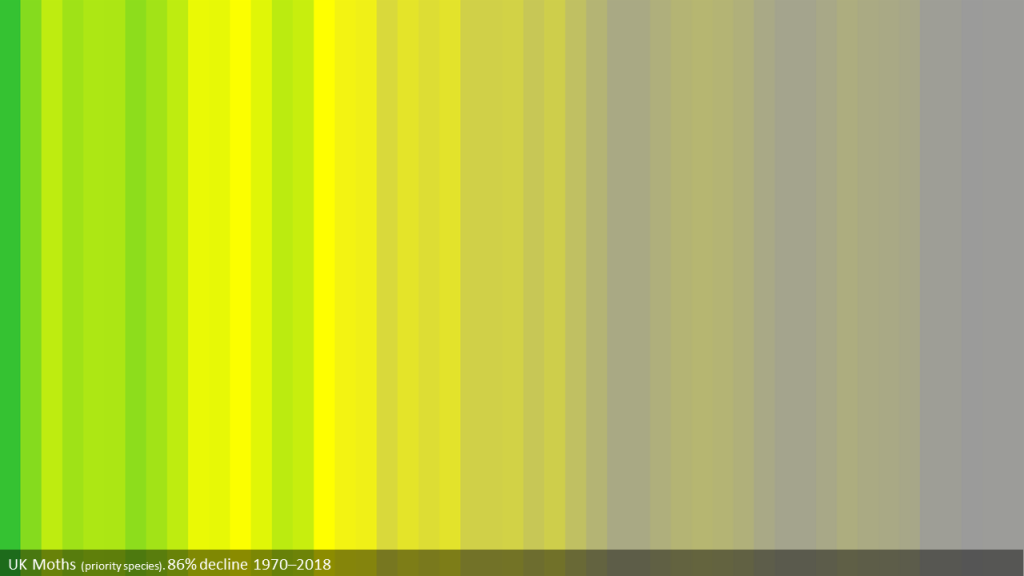
The ‘biodiversity stripes’ provide a visual representation of the change in biodiversity over time, often since 1970. The highest level of biodiversity is coloured bright green. Lower levels move through yellow to grey, depending upon the level of decline. Darker greys appear with greater declines.

This one shows the decline of UK moths from 1970 to 2018

An image showing the decline, 86%,  in British moths from 1970 to 2018  The highest level of biodiversity is coloured bright green. Lower levels move through yellow to grey, depending upon the level of decline. Darker greys appear with greater declines.

86% decline in only part of my lifetime. Horrific. I was 12 in 1970, I remember when cleaning insects from a windshield was a thing.

In 2025, the now-annual survey conducted by Buglife in Kent found a decline of 66% in flying insects since 2021.

Kent bug splat survey shows ‘troubling’ fall in flying insects – BBC News

I am currently reading Aurochs and Auks by John Burnside, a wonderful book, which in part deals with the feelings around this terrible state of affairs.