

I’ve had a half finished draft post about Blogging Bootcamp in the works since the bootcamp finished. I still hope to finish it but thought I used the excuse of the Teaching with WordPress course to post this shortish screencast.
I’ve also got a huge post about the 5Rs presentation I bungled at teachmeetGLA this week which will fit in nicely with #TWP15 too. Perhaps I’ll chop that up and post wee bit as it is getting out of control.
Signing on to #twp15

Fools rush in, foolish fools sign up at the last minute.
I’ve just signed up for Teaching with WordPress
This is an open online course on Teaching with WordPress, running June 1-26, 2015. Join us to talk about and experiment with, among other things:
- open education, open pedagogy and design
- WordPress as a highly customizable framework for teaching and learning
- examples of instructors and learners using WordPress sites in many different ways for multiple purposes
- plug ins, applications and approaches for creating, discussing, sharing and interacting with each other
Throughout the course, you’ll be creating your own WordPress course site, so that by the end you’ll have a beginning structure to build on with your learners.
If I get through 10% of the above I’ll be doing well. The course is organised by Christina Hendricks who I’ve met on etmooc and ds106.
I’ve not started a new blog for the course as I hope anything I post will be relevant to this blog (which I hope focuses on learning).
The course is obviously based in higher ed, but I’ve learnt a lot fro reading HE blogs over the past few years and I don’t think there are any of the learning objective that are not applicable to primary and secondary education.
The course has a Blog Hub where hopefully my post categorised as teachingWP will end up. (this aggregation of learners blogs to a course hub is something I am very excited about, having seen it in action a few times. I recently ran a 10 week blogging bootcamp for Scottish schools using the same technique.
A Brief Introduction
For anyone who ended up here from a #twp15 tweet or the blog hub.
I am a primary teacher by trade, currently working as an ict staff development officer in North Lanarkshire (121 primaries) and seconded to the Scottish Government as a product owner for Glow Blogs.
Glow blogs is a blogging system for Scottish schools. it consists of 33 instances of WordPress. More information on glow blogs on the Help Blog. I guess one of my goals for this course is to improve that help site.
I started blogging with my pupils in Sandaig Primary on Sandaig otters in 2004 using pivot (not wordpress), and organised various other blogs.
This blog started off on pivot in 2005 and I move to WordPress last year, although I used WP elsewhere for several sites. Two of the more interesting ones being ScotEdublogs, an aggregation of Scots Educational Blogs and Edutalk. I have a DS106 blog, the 106 drop in.
My main technical excitements about blogging are RSS and syndication/aggregation. I am interested in giving pupils purpose through audience.
Now we will see if this gets to the mothership.
Life in Links 2015-05-21

- Homework is a Social Justice Issue – Hybrid Pedagogy
While schools can provide low-income students with warmth, food, supplies, and a knowledgeable teacher, asking students to bring essential work home with them may remove those pillars of support from their educational process. Further, making in-class work dependent on progress made at home invites that stress into the classroom and diminishes the positive effect of those support structures that the school has put in place.
Powerful post especially as closing the gap is in the news today. Interesting criticism of flipped learning too.
- Things I Take for Granted #287 – Grabbing Stuff from Web Form Drop Down Lists a really nice geeky post.
I’ve often done similar with a combination of find & replace and multi line editing but this is so much neater (and geekier). Apart from anything else this feeds I need a computer with ‘proper’ apps as opposed to a phone/tablet sometimes. (This post is however pulled together multi app style on an iPad, pinbook and drafts). Read with the last link in this post. I’ve subscribed to Tony Hirst’s blog for years, much flies over my head. But I am ready, or nearly in the zone (ZPD) for this one. - Raspberry Pi Model B+ gets price cut to £16 (Wired UK) I am currently dipping. My toes back in the raspberry pi water tempted to buy a couple just in case.
- speaking of raspberry pis I’ve just set up a Twitter bot on mine DailyCreateBot (@DailyCreateBot) which has been fun. I’ll be blogging more about this.
- Want to Make Your Course ‘Gameful’? A Michigan Professor’s Tool Could Help – Wired Campus – Blogs – The Chronicle of Higher Education
The system lets students choose their own path through a course, selecting the assignments that interest and challenge them. At its heart is a tool, called the “grade predictor,” that helps to “manage some of the chaos” of such a personalized system. The grade predictor also helps students figure out what they need to do to reach the classroom goals they set for themselves.
GradeCraft also aims to give students the ability to fail without detrimental consequences. There are many assignments to choose from, so any students who do poorly on one can find plenty of other tasks to redeem themselves. Instructors, meanwhile, can allow students to revise their work.
Echoes of DS106 and Derek Robertson on failure here.
- An Eye Opening Discussion
I don’t live in a box. I know that teens and adults use different devices for different purposes. But I was still surprised by how unbalanced their responses were compared to what mine (and I suspect most other adults) would be.
Some nice pupil produced diagrams about the devices they use. I wonder if we will miss the sort of skills pointed to in the second link in this post.
Being Swayed
Update August 7, 2015, I managed to delete my example sway by accident on my phone! While swiping to delete another sway the interface hung, I swiped twice and lost both! There is no undelete/undo! Another reason for just blogging I guess.
After testing Slate a while back I though I’d try out Microsoft Sway. I downloaded the app to my phone on the bus and made this while traveling home on bus and train.
Sway feels much like Adobe Slate, I used the same words and pictures to test Slate on my iPad a few posts ago: Chalking my First Slate.
Both Apps produce stylish, responsive webpages with nice fonts, full width images and slick galleries created from blocks of content.
Both host everything for you at no cost. Neither lets you download the work locally.
I am ‘reviewing’ them for a position of using them once. Given Sway is beta and I only used the iPhone app I take everything here with a pinch of salt.
While Slate was iPad only ,the iOS version of Sway is for the iPhone. Sway in the browser seems to be more of a web producer fitting in with your MS office account apps.
I’ve also installed Sway on an iPad and it just scales the interface to fit the screen, it seems to work just as well there as on the phone.
I was surprised to find how pleasant Sway was to use on a phone. The interface made it easy to add the content blocks.
The browser version of Sway allows video and access to photos from Flickr, OneDrive, Youtube and more. Slate give access to Lightroom, Creative Cloud and DropBox. The Sway iPhone app only gives access to your camera roll at the moment.
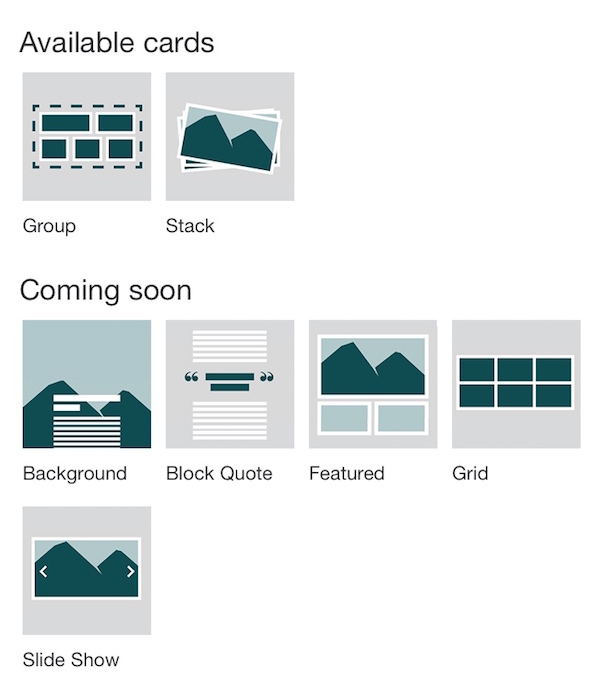
Sway is in preview and the iPhone app indicates that there are more content block (called cards) in the works. Currently you can add Headers (image and text), photos text and More. The more turns out to be ‘cards’ currently groups and stacks of images, more are coming:
Sway on Glow?
When I posted my sway on twitter, I got a reply from someone from Microsoft. I had the chance to ask if Sway would be usable with a edu O365 account:
@johnjohnston @sway We have said it will, but no specific date at this time…
— chris pratley (@chrispr) April 16, 2015
Sway would make a nice presentation tool for use in Glow.
I’ve got a few negative feelings about all of these services.
Firstly the lack of control of the data you publish to them. I’ve watched a few web services disappear. I generally like to at least have an export option. I’d love one of these tools to give you the opportunity to publish to your own space or download copies. That said it seems unlikely any of these companies are going out of business soon.
I also wonder if all of these highly polished presentation tools take away some creativity. Making anything with technology gives a range of choices about how near the metal you get with your tools. If we were trying to teach learners about presentation there are limitations.
Effortless design
Sway’s built-in design engine takes the hassle out of formatting your various pieces of content by integrating them into a cohesive layout. From there, you can easily adjust the design to create a look and feel that reflects your unique style.
from: Office Sway – Create and share amazing stories, presentations, and more
Some might think that the hassle is part of the fun or learning?
I am quite likely wrong about this. I’ve be saying it for a while. I though the same about iMovie trailers, too easy to learn with. But I’ve seen some nice examples of learning using iMovie trailers.
There is also this problem…
Is the Medium the Message?
Both Sway and Slate remind me of medium, I’ve put the same text and images on medium as a comparison.
I also created a home knitted version The Devils Pulpit. This is somewhat less polished, but fun to do.
All three applications are easy to pick up an use. They do not allow much customisation of the layout. Sway having more choices medium the least.
Sway and Slate both offer embed codes, Slate’s is limited to a clickable splash screen that takes you to adobe’s site. Sway’s embed is, in my opinion, much nicer.
For the words and images I was using I prefer Slate’s presentation a little. I like the ‘letterbox’ background images that scroll a lot. I did manage to get these working to some extent (no mobile) on my hand knitted attempt.
Medium is more focused on writing than Sway or Slate.
Medium is the only one that offers something in the way of guidance and suggestions as to what to read. I’ve enjoyed quite a lot of writing on medium through my daily email.
Both Sway and Slate are particularly nice ways to publish when you want your images to be as important as your words. Given Sway has an iPhone app it would be a good choice for using on the move (and on the bus). Sway would be a great tool for producing good looking reports from school trips. For myself I’ll probably stick to blog posts and hand knitted solutions where the fun is in the making.
A Little Aggregation

The new Syndication plugin gives Glow Blogs the ability to bring content in from other sources aggregating content into one space.
For example a School site could aggregate several department or class blogs. This gives the classes/departments a degree of autonomy and control. Schools could decide to only pull in posts with a particular category or tag onto the mothership site.
I’ve been a big fan of aggregation of information ever since I started blogging. Blogs provide a stream of their posts as RSS. This can be used to keep on top of a lot of content through an RSS reader and RSS can be used to distribute information. For example you can show posts from one blog on the sidebar of another with the RSS widget.
Going further than that usually takes a bit more work and either a plugin, specialised software or a workaround. For example on the Blogging Bootcamp I am pulling in links from over 50 blogs through one aggregate RSS feed. The aggregation is being done by an external site inoreader. The only option was to display this in the blog sidebar. I hope to be able to do similar projects from now on with the syndication plugin and displaying posts.
The Syndication Plugin
In phase 2.2 of the Glow Blogs project we added the syndication plugin. This is a simplified version of a more complex plugin being developed by Automattic. The plugin allows you to add RSS feeds so that their posts appear on the syndicating blog. Once you have activated the plugin you can create a group, add sites to it via their RSS feeds and pull that content onto your blog where it is published. Importantly you can set it so that the source link for the post is the original blog and commentators will be redirected there, you do not need to steal the content.
This is what we do on ScotEduBlogs where over 100 blogs are aggregated for easy reading. Until now it would not be possible to do this in Glow.
It is also how the best, in my opinion, course on the internet is run DS106.. There the course activities are posted and participants responses, published on their own sites are pulled in. the syndication plugin will give us a chance to do this inside Glow Blogs.
I’ve started a guide to using the plugin on the Glow Help Blog (Syndication Plugin | Glow Blog Help) and am starting to use the plugin for a couple of projects (#ShareOurLearning | Gathering Learning from around Scotland).
Glow Cast

Glow Cast is a new podcast. Just one episode so far.
As you would imagine it is a podcast about Glow. The idea is to keep the episodes short and fairly casual. The more important function is to demonstrate how easy it s to podcast and provide some resources for would be podcasters.
Glow Blogs now provide a very good podcasting platform. The increase upload file size will ensure that reasonable length podcasts can be published with ease.
I’ve long believed that podcasting is a very underused technology in the classroom. It can be a very motivating tool that can touch on any area of the curriculum as well as hitting multiple literacy experiences. Podcasting can provide great opportunities for projects and collaborative learning. In the past it was quite difficult technically but now it is very simple indeed.
**If you are thinking of dipping your toes into podcasting but are unsure of the first steps check out Glow Cast the resources are only beginning to to build.
#GlowBlogs get your Jetpack on

I’ve not had much time to blog about the Blogs Update Phase 2.2 – WordPress 4.1.2 in Glow Blogs, but I spent a wee bit of time on a new blog showing the features the Blogs gain from jetpack. Imaginatively I called the blog Jetpack. There are lots on nice things for blogs and school websites in Jetpack.
There are a couple of nice new themes and other plugins too. More later.
chicks in trees
Maybe ravens
Callander, Stirling, United Kingdom
This audio file was orginally posted to AudioBoo(m) with the mobile app. It has been added here since audioboom no longer supports free accounts.
Ardinning Roe

Quite a few roe around Loch Ardinning in the evening where I’ve had a few walks this week.
Life in Links 2015-04-12

From Pinboard: bookmarks for johnjohnston for the most part.
- Mediocre Failures | Disappointed Idealist A really powerful post on meeting all children’s needs rather than aiming at passing tests. As it has garnered >600 comments in 4 days I guess it strikes a few nerves. The 4 capacities never looked so good. As I tweeted, if you only read one education blog post…
- Donald Clark Plan B: Sir Ken Robinson: ‘Creative’ with the truth? I’ve never shared the general enthusiasm for Sir Ken that is expressed by many of my colleagues and usually fell like a grump at the party when his name comes up. This makes me feel better.
- I listened to episode 5 Today In Digital Education (TIDE) by Doug Belshaw and Dai Barnes this week and enjoyed it. The podcast seems to have sprung from the death of edtechroundup from way back in 2011. An enjoyable mix of EduTech and Tech.
- Contributions and Connections. What Bonnie Stewart (@bonstewart) found out about how influence and credibility circulate in academic Twitter. It feels pretty much relevant to the other two sectors too. Teachers lack the training in judging relevance and importance of their colleagues that in a central part of academia but still conversation is what counts.
- A couple of posts about things slipping of the web: Where do you go for community? Preserving the Past. I am always interested in this. I recently adding some indieWeb plugins to this site to try and address the roll yr own vs community problem. The Roll Your Own is important in in addressing the preservation one. (posterous to wordpress for edutalk.info)
- OUTSLIDE is pretty silly, a tumblr of strange slides scraped from slide share. I found this via the @katexic Katexic Clippings newsletter which is great.